

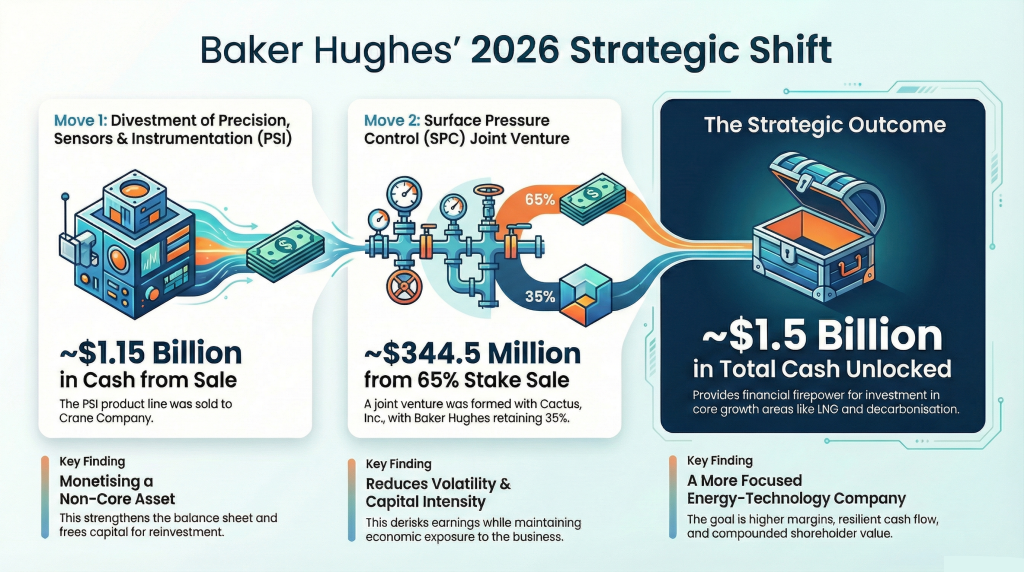
Baker Hughes Company (BKR:NASDAQ) has kicked off 2026 with a decisive pivot, executing two major portfolio moves that signal a clear shift toward a leaner, higher-return energy technology business. By offloading non-core assets and restructuring equipment-heavy segments, the company has unlocked approximately $1.5 billion in cash to fuel its next phase of growth.
Monetizing the Periphery: The $1.15 Billion PSI Divestiture
In early January, Baker Hughes closed the sale of its Precision, Sensors & Instrumentation (PSI) product line to Crane Company. The deal, valued at roughly $1.15 billion in cash before customary adjustments, includes the Druck, Panametrics, and Reuter-Stokes brands.
While these brands provide high-end sensing and measurement technologies for energy, aerospace, and industrial markets, management classified them as peripheral to the company’s core strategy. This monetization is a deliberate step to strengthen the balance sheet, enhance liquidity, and free up capital for reinvestment into higher-growth, higher-margin areas such as LNG and decarbonization solutions.
Mitigating Volatility: The SPC Joint Venture with Cactus, Inc.
Almost in parallel, Baker Hughes finalized a joint venture (JV) for its surface pressure control (SPC) business with Cactus, Inc., which closed on 2 January 2026. Under the terms of the agreement, Cactus acquired a 65% stake, while Baker Hughes retained 35% and received approximately $344.5 million in cash proceeds.
By shifting SPC into a stand-alone JV, Baker Hughes maintains economic exposure to the market while reducing capital intensity and earnings volatility associated with this cyclical, equipment-heavy niche. The partnership aims to leverage Baker Hughes’ installed product base alongside Cactus’ manufacturing and service capabilities to improve competitiveness in wellhead markets.
A Strategic Pivot to Energy Technology
Market analysts view these combined transactions as a consistent step in Baker Hughes’ transition from a diversified oilfield-services player into a focused energy-technology company. The strategy prioritizes structurally higher margins and more resilient cash flows over broad-spectrum services.
The resulting $1.5 billion in “financial firepower” is earmarked for high-priority sectors, including LNG infrastructure, data-center power solutions, and carbon-management technologies such as the CarbonEdge CCUS platform. For investors, the message is that portfolio pruning is now a central lever intended to derisk earnings and compound shareholder value through disciplined capital deployment.