

The Boeing Company (NYSE: BA) has entered a critical phase in its turnaround efforts, following an extended period of financial and operational pressure linked to safety concerns. The market will be closely watching the aircraft maker’s upcoming earnings report, looking for updates on its recovery strategy.
Gaining Altitude?
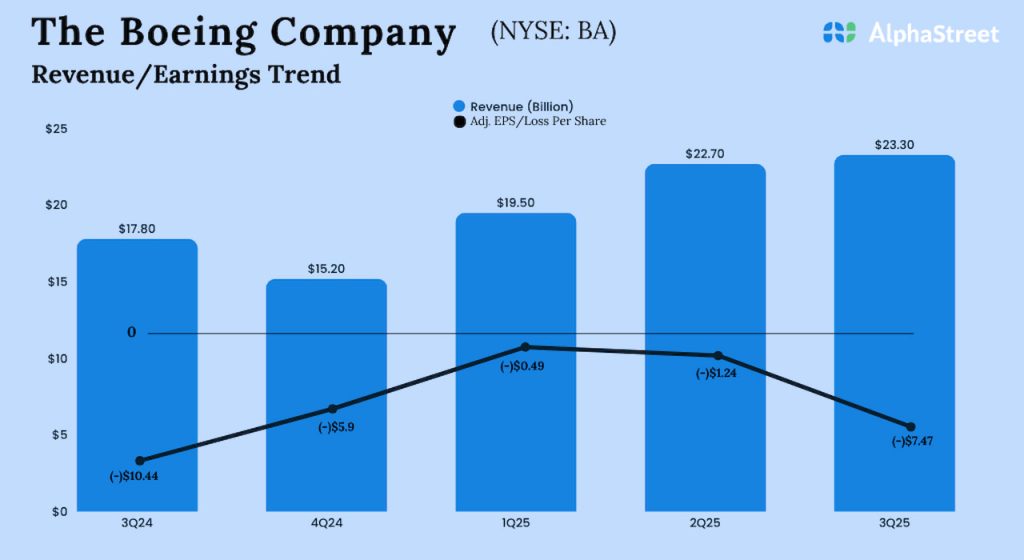
Boeing is planning to publish its fourth-quarter 2025 results on Tuesday, January 27, at 7:30 am ET. It is estimated that the company incurred a loss of $0.44 per share in the December quarter, which marks a significant improvement from the prior-year quarter when it recorded a loss of $5.9 per share. The positive outlook reflects an estimated 48.8% surge in fourth-quarter revenues to $22.67 billion. In the third quarter, the bottom line missed expectations.
Boeing’s stock has risen about 45% over the past twelve months, comfortably outperforming the broader market. Even after this rally, the company’s valuation remains relatively undemanding, reflecting both the progress made and the work still ahead in its turnaround. There is optimism around further gains this year, underpinned by improving operational execution and greater stability across key programs. As such, BA remains a stock worth monitoring for those looking for long-term investments.
Loss Narrows
For the third quarter, Boeing reported a loss of $7.47 per share, adjusted for special items, compared to a loss of $10.44 per share in the year-ago quarter. On a reported basis, net loss was $5.34 billion or $7.14 per share in Q3, compared to a loss of $6.17 billion or $9.97 per share in the third quarter of 2024. Revenues increased 30% year-over-year to $23.27 billion in the September quarter, beating estimates. Revenues grew in double-digits across all three operating segments.
From Boeing’s Q3 2025 Earnings Call:
“Supported by greater stability, we successfully ramped up 737 production to 38 airplanes per month as we had planned. We then focused on enablers such as improved quality, training, and workplace coaches to help stabilize at that rate and demonstrate that all of our key performance indicators are healthy. Once we’re satisfied with the sustained health and stability of the production system, we then presented our disciplined plan to the FAA to increase production to 42 airplanes a month. We continue to be guided by our safety and quality plan, and we’ll monitor our performance against these six KPIs as we methodically move to higher rates.”
On Track
Boeing recently raised the production rate of the 737 to 42 aircraft per month, up from a stabilized level of 38, with plans for further increases in the coming months. The defense division delivered strong growth last year, supported by major contract wins and multi‑year agreements, driving the backlog to an all‑time high. Although certification and the first delivery of the new 777X have been delayed, the program is expected to provide a significant lift to the business, as the widebody jet is designed to be highly fuel‑efficient and offer a clear competitive edge.
While Boeing’s 52-week average stands at $201.65, the stock continues to trade well above that level, nearing its yearly high. On Tuesday, shares opened lower at $244.40.