

Telefonaktiebolaget LM Ericsson (ERIC-B.ST / NASDAQ:ERIC) is a Swedish telecommunications equipment supplier providing mobile network infrastructure, software, and services to operators and enterprises globally, with core exposure to 5G radio access networks and cloud-based telecom platforms.
Ericsson shares rose about 11% in Stockholm trading after the company reported fourth-quarter 2025 earnings that exceeded market expectations, supported by continued margin expansion and strong cash generation. The stock has recovered sharply from a 52-week low near SEK 65, though it remains below earlier 2025 highs. Following the move, Ericsson’s market capitalization stood near SEK 285 billion.
Financial Performance
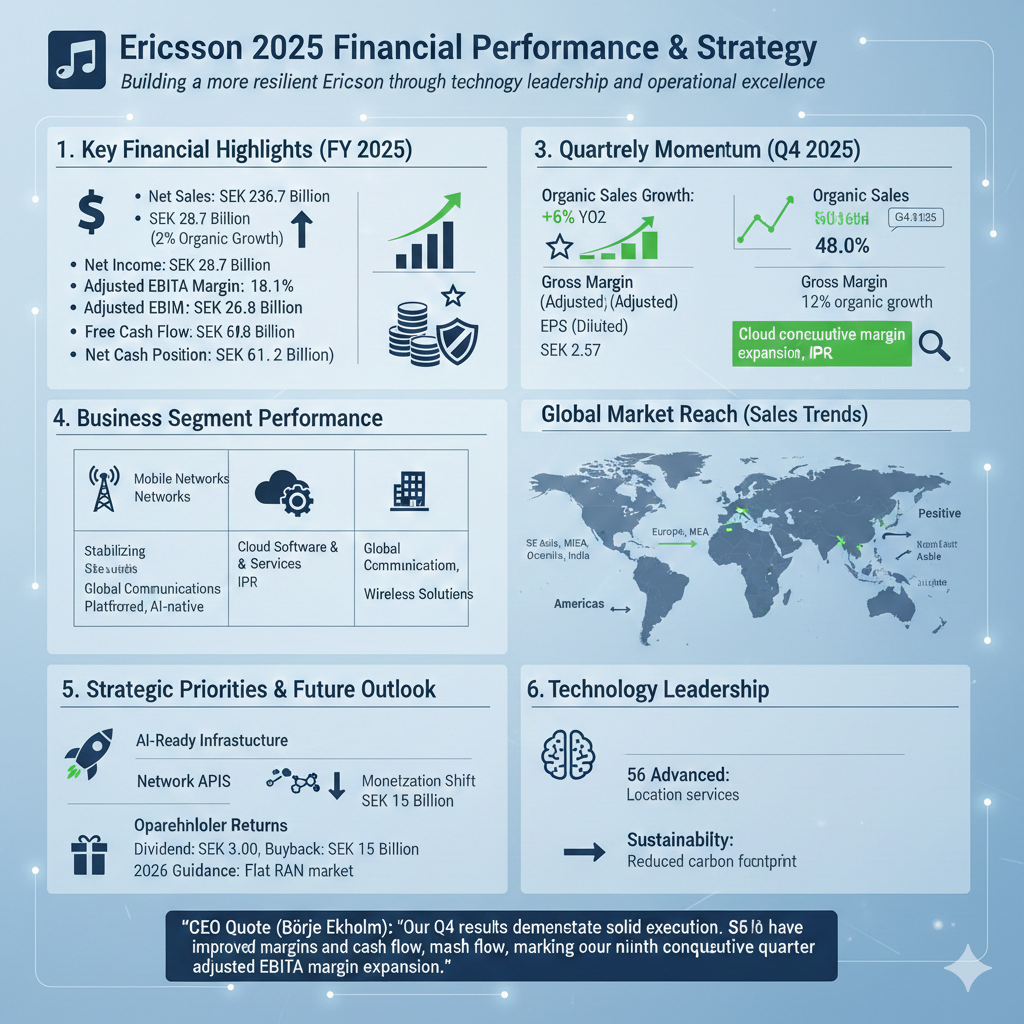
Ericsson reported Q4 net sales of SEK 69.3 billion, down 5% year over year on a reported basis due to currency headwinds. On an organic basis, sales increased 6%, indicating stabilization in underlying demand after a prolonged downturn in global telecom capital spending.
Profitability remained the primary upside driver. Adjusted EBITA rose to SEK 12.7 billion, lifting the adjusted EBITA margin to 18.3%, up from 14.1% a year earlier. This marked the ninth consecutive quarter of year-on-year adjusted EBITA margin expansion, reflecting sustained cost discipline, improved contract execution, and favorable business mix. Gross margin improved to 47.2% from 44.9%.

Net income totaled SEK 8.6 billion, with diluted earnings per share of SEK 2.57. Free cash flow before M&A was SEK 14.9 billion, supported by lower restructuring cash outflows and tighter working-capital management.
Business Segment Performance
By business area, Networks, which remains Ericsson’s largest division, delivered modest organic growth despite a broadly flat radio access network (RAN) market. Performance was supported by deployments in Europe and parts of Asia, partially offset by weaker demand in North East Asia.
Cloud Software and Services posted the strongest growth, delivering double-digit organic expansion, reflecting continued traction in core network modernization and digital services. The Enterprise segment also contributed positively, benefiting from demand for private networks and mission-critical communications.

Regional Performance
Regionally, organic growth was led by Europe, the Middle East, and Africa, where operator investment levels stabilized. South East Asia, Oceania, and India also recorded growth, supported by ongoing network rollouts. These gains were offset by declines in North East Asia, while North America remained broadly flat.

Full-Year Context & Margin Trend
For full-year 2025, Ericsson reported sales of SEK 236.7 billion, down 5% on a reported basis but up 2% organically. Adjusted EBITA rose to SEK 42.9 billion, lifting the full-year margin to 18.1%, up sharply from 11.0% in 2024. The margin recovery reflects a structural reset following the earlier 5G investment cycle, rather than a rebound in volumes.
Net income for the year increased to SEK 28.7 billion, aided by improved operating performance and a divestment gain related to iconectiv.
Net Cash
Ericsson ended 2025 with net cash of SEK 61.2 billion, up from SEK 37.8 billion a year earlier. The increase was driven primarily by strong operating cash flow and lower restructuring payments, partially offset by dividend payments and capital expenditures. Currency movements had a limited impact on net cash during the period.

Guidance & Capital Allocation
Ericsson did not issue formal quantitative guidance for 2026. Management reiterated expectations for a flat RAN market, signaling limited visibility on revenue growth. Focus remains on cost efficiency, selective investment, and protecting margins.
The company proposed a SEK 3.00 dividend and announced a SEK 15 billion share buyback, its first, reflecting increased confidence in cash generation and balance sheet strength.
Sector & Competition
Ericsson competes primarily with Nokia among Western telecom equipment vendors, while facing sustained pricing pressure from Chinese suppliers in emerging markets. Regulatory restrictions on high-risk vendors in Europe and North America continue to provide some support, though operator spending remains constrained by leverage and muted end-market growth.
Bottom Line
Ericsson’s fourth-quarter results reinforced a clear investment narrative shift toward margin durability, cash flow, and capital returns, rather than revenue growth. With the RAN market expected to remain flat, equity performance will likely hinge on continued execution and margin discipline rather than a cyclical recovery in telecom spending.