
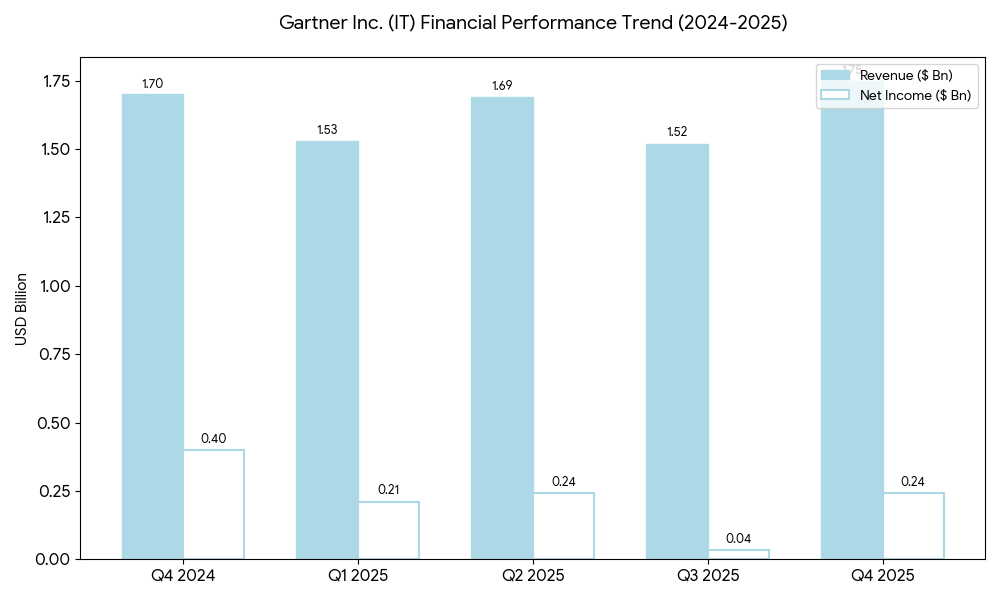
Gartner, Inc. (NYSE: IT) reported mixed financial results for the fourth quarter and full year ended December 31, 2025, delivering steady revenue growth while encountering softer profitability and cash generation amid a shifting technology spending environment.
For the fourth quarter, the research and advisory firm generated revenue of approximately $1.8 billion, representing a 2% year-over-year increase. Adjusted earnings per share (EPS) came in at $3.94, surpassing analyst expectations and underscoring resilient demand for its subscription-based insights and advisory offerings.
Full-Year Performance Reflects Steady Expansion
For the full year, Gartner recorded revenue of about $6.5 billion, up 4% from 2024, supported by continued enterprise demand for strategic guidance, particularly in areas such as artificial intelligence and digital transformation.
Adjusted EPS reached $13.17, while free cash flow totaled roughly $1.2 billion, highlighting the company’s ability to generate strong liquidity despite macroeconomic uncertainty. The firm also maintained solid profitability metrics, with EBITDA of $1.6 billion and margins near 24.8%, exceeding its initial outlook for the year.
However, operating cash flow and free cash flow declined in the fourth quarter compared with the prior year, signaling tighter financial conditions. Analysts and investors have increasingly focused on these metrics as indicators of future flexibility and investment capacity.
Segment Strength Driven by Recurring Revenue
Gartner’s largest business—its subscription-based insights segment—continued to anchor performance. Quarterly insights revenue rose 3% year over year, while full-year revenue in the segment increased 5%, supported by strong retention and recurring revenue characteristics.
Contract value stood at approximately $5.2 billion at year-end, reflecting incremental growth despite headwinds related to U.S. federal government contracts that came up for renewal during the year.
The company emphasized that upfront payments within its subscription model help generate cash flows that often exceed net income, reinforcing the structural strength of its business model even during periods of slower top-line expansion.
Balancing Growth Investments and Capital Returns
Alongside operational execution, Gartner stepped up capital returns, including share repurchases, as part of its broader financial strategy. Management has also highlighted AI-driven opportunities and enterprise technology modernization as long-term demand drivers, positioning the firm to benefit from ongoing digital transformation initiatives.
Still, the results point to a transitional phase. While revenue growth remained positive, the combination of lower profitability and reduced cash generation illustrates the challenges facing advisory firms as clients scrutinize technology budgets and prioritize measurable returns.
Outlook
Gartner’s 2025 performance ultimately reflects a business that continues to expand, albeit at a measured pace. The company retains strong recurring revenue streams, healthy margins, and robust free cash flow, yet must navigate market volatility and evolving enterprise spending patterns. As organizations increasingly seek guidance on complex technology decisions, Gartner’s ability to sustain contract growth and translate demand into consistent financial performance will remain central to its trajectory in the coming years.