

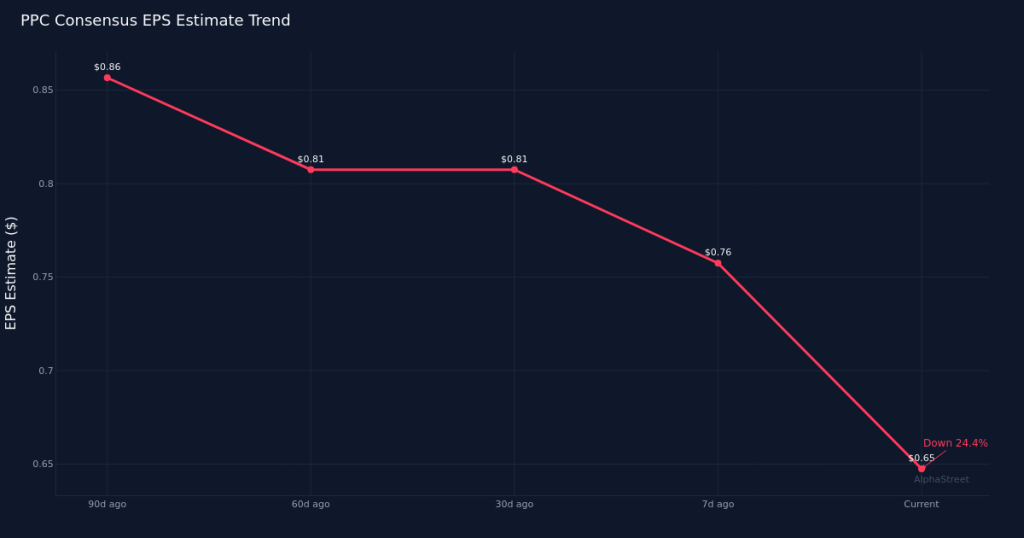
Wall Street expects a sharp profitability decline. Pilgrim’s Pride Corporation (NASDAQ:PPC) is scheduled to report first-quarter fiscal 2026 results on April 30, with analysts projecting earnings of $0.65 per share on revenue of $4.41 billion. Four analysts cover the stock, with EPS estimates ranging from $0.57 to $0.71 and revenue projections spanning $4.24 billion to $4.55 billion. The consensus figures reflect a challenging environment for the poultry producer as it navigates a difficult comparison period.
Analyst sentiment has deteriorated sharply. Estimate revisions tell a concerning story heading into the print. The consensus EPS forecast has fallen down 19.8% over the past 30 days from $0.81, while the 90-day drift shows an even steeper down 24.4% decline from $0.86. This sustained downward pressure on estimates signals that analysts have grown increasingly cautious about Pilgrim’s near-term profitability outlook, with Wall Street progressively marking down expectations as the quarter unfolded. The magnitude and consistency of these cuts suggest fundamental headwinds rather than minor adjustments.
Year-over-year comparisons reveal a profitability squeeze. The consensus EPS of $0.65 represents a decline of 50.4% compared to year-ago earnings of $1.31 per share in the first quarter of fiscal 2025. Revenue is expected to slip 1.1% year-over-year from $4.46 billion, a relatively modest top-line decline that contrasts sharply with the profit deterioration. Last year’s quarter delivered net income of $312.6 million and a net margin of 7.0%, providing a stark baseline against which to measure the current period’s performance. The divergence between modest revenue pressure and significant earnings compression points to margin degradation in the packaged foods business, likely reflecting higher input costs, unfavorable pricing dynamics, or operational inefficiencies that have emerged over the past year.
Margin trajectory will be critical. For a protein producer like Pilgrim’s Pride, the relationship between feed costs, live production expenses, and realized pricing determines profitability. The year-ago net margin of 7.0% established a benchmark that appears increasingly difficult to maintain based on current analyst projections. Investors will scrutinize whether margin pressure stems from elevated grain costs squeezing the cost structure, competitive pricing dynamics limiting the company’s ability to pass through inflation, or operational challenges at production facilities. The packaged foods sector has faced broader inflationary headwinds, but the severity of Pilgrim’s projected earnings decline suggests company-specific or poultry-specific factors may be at work.
Production volumes and pricing power deserve focus. While specific operational metrics for prior quarters are not available in the current dataset, Pilgrim’s business model revolves around production volume, average selling prices, and the spread between poultry prices and feed costs. The slight revenue decline alongside collapsing profitability suggests either volume weakness, unfavorable pricing, or both. Investors should monitor whether the company is maintaining market share or ceding ground to competitors, and whether fresh chicken, prepared foods, or export channels are experiencing divergent trends.
Stock positioning reflects uncertainty. The magnitude of estimate cuts and the challenging year-over-year comparison create a low bar for the actual results, but also signal genuine concern about the operating environment. How shares react will depend not only on whether Pilgrim’s meets the reduced expectations but also on management’s outlook commentary and any signs of stabilization or improvement in the margin profile for subsequent quarters.
This content is for informational purposes only and should not be considered investment advice. AlphaStreet Intelligence analyzes financial data using AI to deliver fast and accurate market information. Human editors verify content.