

Seacoast Banking Corporation of Florida (NASDAQ: SBCF) reported fourth-quarter and full-year 2025 financial results on Thursday, characterized by significant balance sheet expansion following the completion of a major acquisition. While the bank outperformed revenue expectations, its bottom-line results were dampened by merger-related expenses and credit provisions linked to its purchase of Villages Bancorporation, Inc. (VBI). Following the announcement, Seacoast shares saw a moderate decline in early trading as investors weighed robust organic loan growth against an earnings miss.
Transformational Acquisition Drives Scale
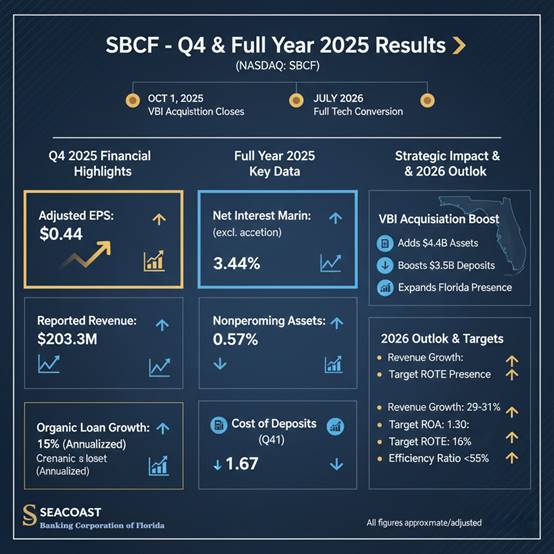
The definitive highlight of the period was the October 1, 2025, closing of the VBI acquisition. This transaction fundamentally altered the bank’s scale in the Florida market, adding approximately $4.4 billion in assets, $3.5 billion in deposits, and $1.2 billion in loans.
The integration has significantly bolstered Seacoast’s presence in high-growth regions, particularly within The Villages community. Management indicated that while the legal merger is complete, the full technology and systems conversion is scheduled for July 2026. To optimize the acquired balance sheet, the bank sold approximately $1.5 billion of the $2.5 billion in securities acquired through VBI, reinvesting the proceeds into higher-yielding positions at an average yield of 5.3%.
Financial Performance and Data Summary
Seacoast reported fourth-quarter net income of $34.3 million, which included $18.1 million in merger and integration costs. On an adjusted basis—excluding these one-time items—net income stood at $47.7 million, an 18% increase over the same period in 2024.
Fourth Quarter 2025 Key Metrics:
- Earnings Per Share (EPS): Reported at $0.44 (adjusted), missing the consensus analyst estimate of $0.49–$0.50.
- Total Revenue: Reached $203.3 million, up 43.6% year-over-year, surpassing the projected $201.25 million.
- Net Interest Margin (NIM): Expanded to 3.44% (excluding accretion), a 12-basis-point increase from the prior quarter.
- Loan Growth: Total loans reached $12.6 billion; organic loan growth (excluding the VBI acquisition) was 15% on an annualized basis.
- Efficiency Ratio: The adjusted efficiency ratio improved to 54.5%, down from 60.0% in the prior-year quarter.
For the full year 2025, the bank reported net income of $144.9 million. The expansion of the net interest margin was a primary driver, aided by a disciplined approach to deposit pricing. The cost of deposits for the fourth quarter fell to 1.67%, a 14-basis-point decrease from the third quarter, reflecting the influx of lower-cost funding from the VBI portfolio.
Asset Quality and Capital Position
Despite the rapid expansion, credit quality remained stable. Nonperforming loans decreased to 0.57% of total loans, down from 0.90% at the end of 2024. Net charge-offs were a marginal 3 basis points for the quarter.
The bank’s capital position remains robust:
- Tier 1 Capital Ratio: 14.4%
- Tangible Equity to Tangible Assets: 9.3%
- Tangible Book Value per Share: $17.61, up from $16.12 a year earlier.
The allowance for credit losses was increased to 1.42% of total loans, primarily due to the “day-one” credit provision of $23.4 million required under accounting standards for the VBI acquisition.
2026 Strategy and Outlook
Looking ahead, Seacoast management provided an optimistic forecast for the coming fiscal year, targeting significant revenue synergies from its expanded footprint. The bank anticipates:
- Adjusted Revenue Growth: 29% to 31% for the full year 2026.
- Adjusted EPS Guidance: $2.48 to $2.52.
- Operational Targets: An adjusted return on assets (ROA) of 1.30% and a return on tangible equity (ROTE) of approximately 16% by the end of 2026.
Strategy remains focused on organic growth and the diversification of income streams. Wealth management assets under management reached $2.8 billion, a 37% year-over-year increase, signaling a reduced reliance on pure interest-rate spreads.
Market and Macro Context
The results come as regional banks in Florida continue to benefit from strong inward migration and a resilient local economy. However, Seacoast’s performance highlights the ongoing challenge for mid-tier lenders: balancing aggressive M&A growth with the immediate impact of merger-related expenses and the necessity of managing deposit costs in a “higher-for-longer” interest rate environment. The market’s reaction suggests that while the strategic rationale for the VBI merger is clear, execution risks regarding the mid-2026 technology conversion remain a point of observation for investors.