
Good news for tech giants; smart speakers are all set to take over the world. According to Deloitte’s Technology, Media and Telecommunications Predictions report for 2019, global smart speaker industry is expected to grow 63% to $7 billion next year.
Companies including Amazon (AMZN) and Google (GOOGL) will sell over 164 million units of smart speakers in 2019, compared to just about 98 million units this year, making it the fastest-growing connected device in the world, the report states.
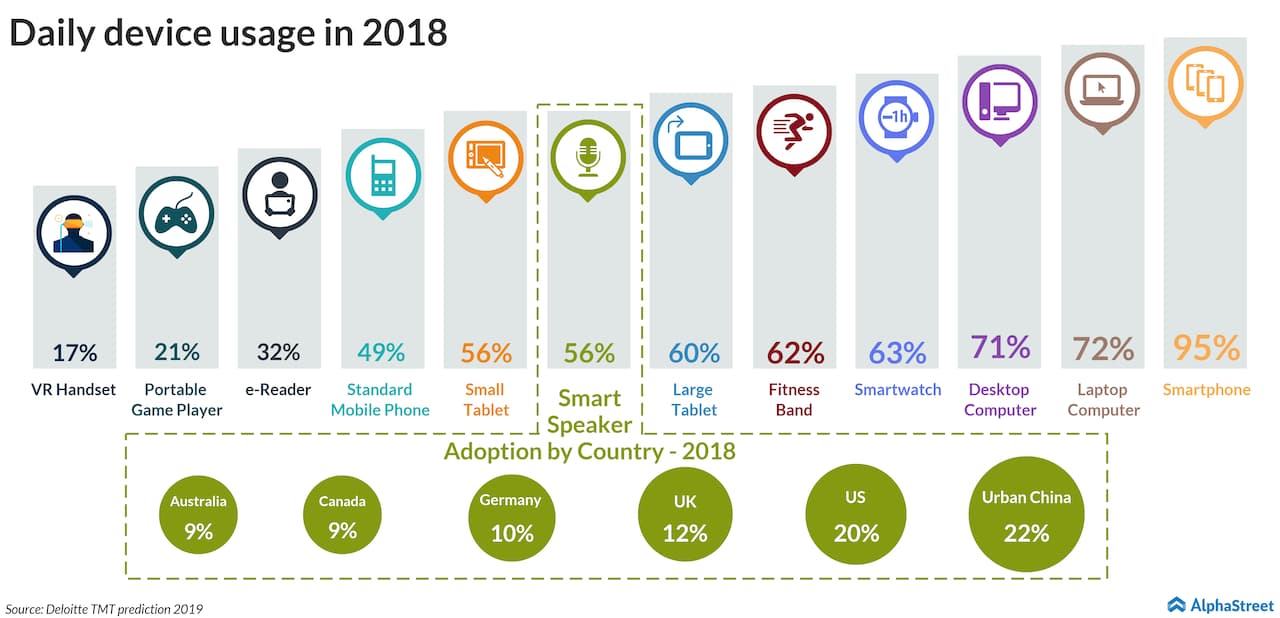
Meanwhile, the average selling price is expected to edge down to $43 from $44 in 2018.
By next year, Deloitte expects most of the manufacturers to break the language barrier faced by smart speakers by incorporating recognition for more regional languages. This will help the device penetrate deeper into markets where most people speak Spanish, Chinese, Japanese, French or Italian.
The report adds that the rising adoption of smart devices in hotels, hospitals and classrooms will benefit these devices in the long-term. The Marriott International Group (MAR) and Wynn Resorts (WYNN) have already started mass installation of smart speakers made by Amazon and Alibaba (BABA).
Amazon’s Alexa will soon be your voice assistant in hotel rooms [VIDEO]
The report suggests that a smart speaker is an ideal way to communicate with machines for physically impaired or uneducated people, both of which together make up a lion’s share of the global population. Though voice assistants are currently available in smartphones and laptops as well, the Deloitte report has revealed that most people don’t use them or are not even aware of them.
However, since smart speakers cannot be operated without voice commands, the feature works better with this device.