
Equipment rental operator United Rentals (URI) reported better than expected first quarter earnings backed by higher rental revenue. The company, which has earthmovers, forklifts, and other heavy equipment, is facing a step back in the industry as the recent data showed weak construction spending. Shares of United Rentals inched 0.83% up after the market close on Wednesday.
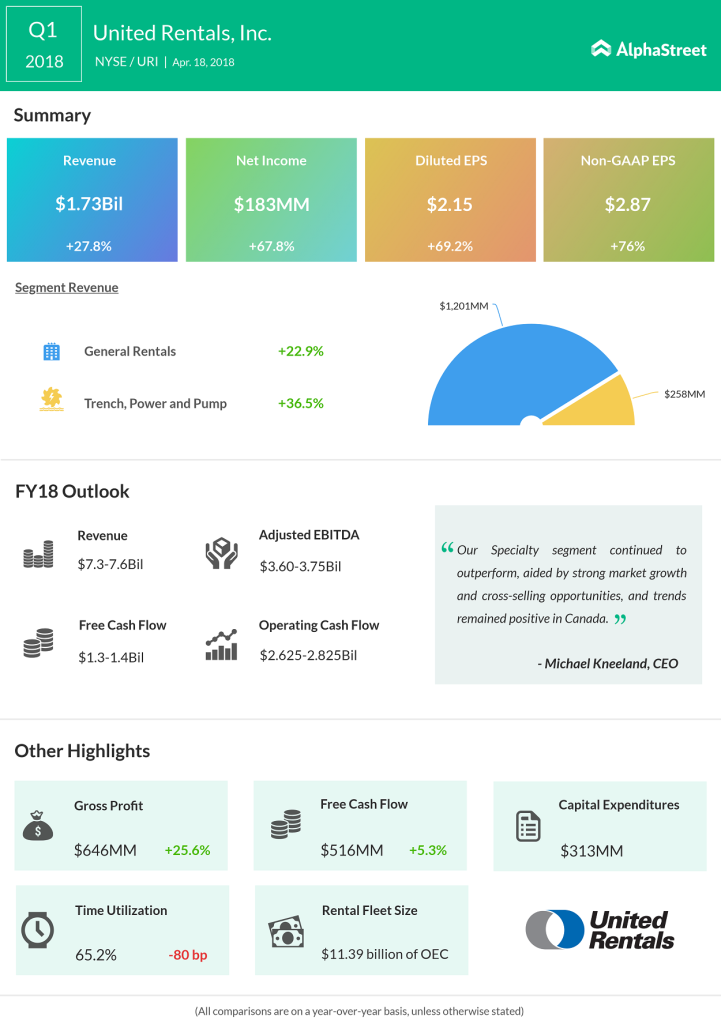
With total revenue jumping 28% to about $1.73 billion, the world’s largest equipment rental company saw its earnings for the quarter soar 68% higher to $183 million or $2.15 per share. The results included a benefit associated with new tax reform. Adjusted earnings per share climbed 76% to $2.87. A climb in the volume of equipment on rent and higher rental rates helped the total revenue spurt.
The company’s rental revenue improved 25.1% helped by strong organic growth, which is led by acquisitions of NES Rentals and Neff Corp. and improving end-market demand. Time utilization fell 80 basis points to 65.2% due to the impact of NES and Neff acquisitions. Trench, Power and Pump specialty segment’s rental revenue increased by 36.5%, primarily on a same-store basis.
The company’s significantly larger fleet size in strong used equipment market and timing impact of earlier recognition of certain sales in 2018 drove used equipment sales higher as known from 71% growth in proceeds generated. United Rentals’ prospects are enhanced by prudent fleet investments, accretive acquisitions, project XL initiatives, and robust market demand.
Looking ahead into fiscal 2018, United Rentals reaffirmed its outlook. The company continues to expect total revenue between $7.3 billion and $7.6 billion, and adjusted EBITDA of $3.60-$3.75 billion for the full year. The company reaffirmed its forecast for net cash provided by operating activities of $2.625-$2.825 billion, and free cash flow of $1.3-$1.4 billion.

Return on invested capital for the twelve months ended March 31, 2018, grew to 9.4% from 8.4% last year, helped by the new tax reform. The company expects ROIC to increase due to the reduced tax rates materially. In addition, the board of directors authorized a new $1.25-billion share repurchase program, which is intended to complete by the end of 2019.
On the recommendation trends front, ten of the eighteen analysts are expecting a “hold” rating and six are predicting a “buy” or “strong buy” rating. On growth estimates front, the consensus is seeing a 39% growth during the current year and a 10.60% jump in the next year.
United Rentals can weather US-China trade war tensions as it focuses on the domestic market. The company has 91.5% of its sales coming from the US and the rest from Canada. The company gets 50% of orders from industrial and non-construction rentals, and 46% from commercial construction. CNBC’s Jim Cramer found United Rentals, the stock, and the company, to be much more attractive than Caterpillar (CAT).