

AlphaStreet Newsdesk powered by AlphaStreet Intelligence
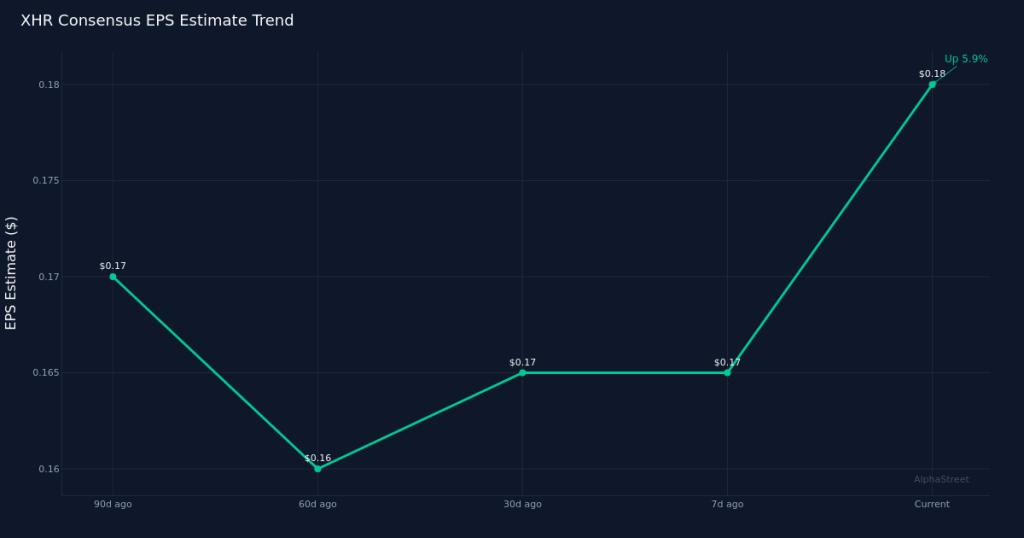
Wall Street expects modest growth when Xenia Hotels & Resorts reports first-quarter 2026 results on May 1. The consensus among 2 analysts calls for earnings per share of $0.18 on revenue of $290.1 million. The revenue estimate range spans from $281.9 million to $294.9 million, reflecting relatively tight dispersion among the limited analyst coverage.
Analyst sentiment has turned incrementally more positive heading into the print. The EPS consensus has drifted upward by 5.9% over the past 30 days, rising from $0.17 to the current $0.18 estimate. That same 5.9% upward revision has held over the 90-day window, signaling a sustained reassessment rather than a last-minute adjustment. For a hotel REIT operating in what can be a volatile lodging environment, this steady upward drift suggests analysts see improving visibility on occupancy, average daily rates, or both as the spring travel season unfolds.
The year-over-year comparison points to solid earnings growth against a flattish revenue backdrop. Consensus EPS of $0.18 would represent a 20.0% increase from the $0.15 per share Xenia delivered in the first quarter of 2025. Revenue, by contrast, is expected to edge up just 0.4%, from $288.9 million a year ago to the current $290.1 million estimate. This divergence implies margin expansion and improved operational efficiency within the portfolio. Last year’s first quarter generated net income of $16.8 million on a net margin of 5.8%, establishing a baseline profitability level that the market will measure against when results are released.
Context on the lodging REIT sector matters here. Hotel REITs like Xenia are highly sensitive to shifts in business and leisure travel demand, corporate group bookings, and pricing power within their specific markets. The company’s portfolio typically includes upscale and upper-upscale properties, often in urban and destination markets where performance can vary widely based on local events, corporate travel patterns, and consumer confidence. Investors will scrutinize key hotel operating metrics such as revenue per available room (RevPAR), occupancy rates, and average daily rate (ADR) trends across the portfolio to understand whether the implied margin improvement is sustainable or driven by one-time factors.
The first quarter is historically a lighter earnings period for hotel REITs, sandwiched between holiday travel and the summer peak season. Weather disruptions, the timing of corporate conferences, and spring break patterns can all influence results. The fact that analysts have raised estimates despite these seasonal headwinds may indicate confidence that demand fundamentals remain resilient. The hotel sector has also been navigating a normalization phase following post-pandemic travel surges, making year-over-year comparisons particularly telling about underlying momentum versus easier prior-year comparisons.
Without detailed prior-quarter data available, investors will need to listen closely to management’s commentary on sequential trends and forward guidance. Hotel operators typically provide color on booking windows, group business on the books, and transient demand patterns that offer visibility into the second quarter and summer travel season. Any commentary on property-level capital investment, potential asset sales or acquisitions, and the broader transaction environment for lodging assets will also be important given the REIT structure and the company’s capital allocation priorities.
Xenia’s track record on estimate accuracy and the stock’s technical positioning ahead of the report are not included in the available data. Investors should consult recent price action and volatility measures independently to assess how the market is positioned for potential surprises.
This content is for informational purposes only and should not be considered investment advice. AlphaStreet Intelligence analyzes financial data using AI to deliver fast and accurate market information. Human editors verify content.