
American Airlines (AAL) recorded strong passenger traffic during the holiday travel season, which pushed up the company’s revenues in the fourth quarter. Shares of the airline gained sharply Thursday after it reported better than expected earnings and issued positive guidance for fiscal 2019.
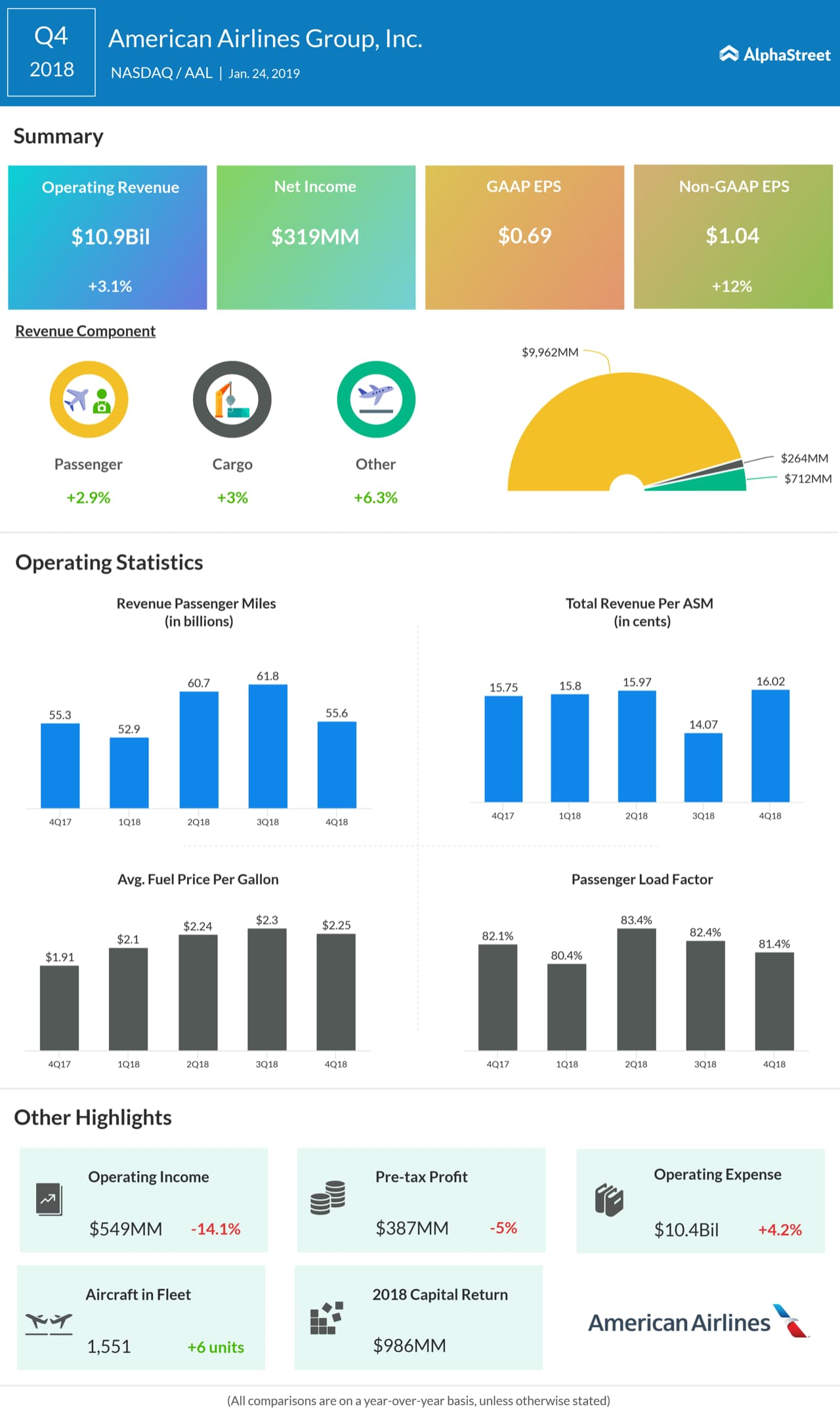
Adjusted earnings of the world’s largest airline climbed to $1.04 per share in the December quarter from $0.93 per share in the year-ago period and came in above analysts’ forecast. On a reported basis, the company posted a net profit of $319 million or $0.69 per share, compared to a loss of $583 million or $1.22 per share a year earlier.
Total operating revenue climbed 3% year-over-year to $10.94 billion during the three-month period but missed the Wall Street estimates. Passenger revenue was up 2.8% compared to last year. The strong topline performance more than offset an uptick in operating expenses, led by a 20% rise in fuel costs.
Passenger revenue per available seat mile (PRASM) moved up 1.4% 14.59 cents during the quarter, while total revenue per available seat mile (TRASM) rose 1.7% annually.
Doug Parker, the company’s CEO, said, “We enter 2019 with great momentum. We are intent upon running the most reliable operation in our post-merger history, pursuing high margin growth opportunities at our most profitable hubs, and executing on a number of valuable revenue and cost saving initiatives.”
The strong topline performance more than offset an uptick in operating expenses, led by a 20% rise in fuel costs
Encouraged by the upbeat results, the management predicts a 40% annual growth in adjusted earnings in fiscal 2019 when TRASM is seen outperforming the industry. A comprehensive cost improvement program is being implemented this year, which is expected to create $300 million of annual cost savings by eliminating post-merger cost redundancies.
The company forecasts adjusted earnings between $5.50 per share and $7.50 per share for fiscal 2019. In the first quarter, total revenue available per seat miles (TRASM) is expected to be flat to up 2%, while pre-tax margin excluding net special items is estimated to come in the range of 2.5% to 4.5%.
Earnings: Southwest Airlines Q4 earnings slide despite beating estimates
In the December quarter, the board of directors declared a cash dividend of $0.10 per share, payable on February 20, 2019, to stockholders of record as of February 6, 2019.
American Airlines’ shares dropped more than 40% in the past twelve months. The stock gained about 6% in early trading Thursday following the earnings report, after closing the last trading session lower.