

Apple Inc. (NASDAQ: AAPL) reported record-breaking financial results for its fiscal 2026 first quarter, significantly exceeding Wall Street estimates on the back of resilient iPhone demand and a deepening expansion of its Services ecosystem. Following the announcement, shares of the technology giant rose approximately 0.72% in after-hours trading, reflecting investor confidence in the company’s ability to navigate supply chain headwinds.
Fiscal First Quarter Financial Summary
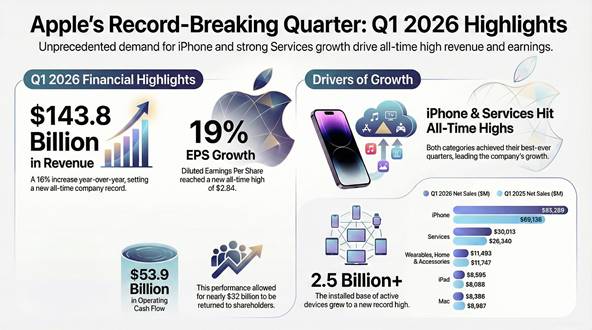
For the quarter ended December 27, 2025, Apple posted revenue of $143.8 billion, representing a 16% increase compared to the same period a year ago. Diluted earnings per share (EPS) reached an all-time high of $2.84, a 19% year-over-year jump that outperformed the consensus analyst forecast of $2.67.
The company’s profitability was supported by a gross margin of 48.2%, which sat above the top end of management’s previous guidance. This expansion was primarily attributed to a favorable product mix and operational leverage, despite a reported $1.4 billion impact from ongoing tariffs.
Segment Performance and Hardware Cycles
The primary driver for the record quarter was the iPhone, which saw revenue climb 23% to $85.3 billion. This performance marks the strongest quarterly growth for the product line in over four years, fueled by high adoption rates for the iPhone 17 series.
While hardware performance was strong in the handset division, other categories showed mixed results:
- Services: Reached a record $30.0 billion, up 14% year-over-year, with all-time highs in advertising, cloud services, and payment platforms.
- iPad: Revenue rose 6% to $8.6 billion, supported by a high volume of customers new to the platform.
- Mac: Revenue declined 7% to $8.4 billion, facing difficult comparisons against a high volume of product launches in the prior-year quarter.
- Wearables, Home, and Accessories: Sales dipped 2% to $11.5 billion, a decline management attributed to supply constraints affecting the AirPods Pro 3.
Geographic Growth and Emerging Markets
Apple reported revenue growth across nearly all geographic segments, with all-time records in the Americas, Europe, Japan, and the Rest of Asia Pacific. Notably, revenue in Greater China surged 38% year-over-year, a significant stabilization following previous concerns over regional competition.
Emerging markets, led by India, continued to show double-digit momentum, contributing to an active installed base that has now surpassed 2.5 billion devices globally.
Strategy and Business Outlook
The company generated $53.9 billion in operating cash flow during the quarter, allowing for a return of nearly $32 billion to shareholders through dividends and share repurchases. The board of directors declared a cash dividend of $0.26 per share, payable on February 12, 2026.
Looking ahead to the March quarter, Apple provided the following guidance:
- Revenue Growth: Expected to range between 13% and 16% year-over-year.
- Gross Margin: Forecasted between 48% and 49%.
- Services Growth: Anticipated to maintain a trajectory similar to the December quarter.
Macro Context and Challenges
Despite the record results, Apple executives noted that the company is currently in a “supply chase” mode. Constraints on advanced silicon nodes—specifically 3-nanometer technology—have made it difficult to balance supply with the “staggering” demand for premium iPhone models. Furthermore, management cautioned that rising costs for memory components are expected to exert pressure on margins in the second fiscal quarter. This supply environment remains a focal point for analysts, as the broader industry grapples with memory shortages and the prioritization of chips for AI data centers.