Company Description
Black Hills Corporation is a customer-focused energy company headquartered in Rapid City, South Dakota. It operates regulated electric and natural gas utilities across eight states: Arkansas, Colorado, Iowa, Kansas, Montana, Nebraska, South Dakota, and Wyoming. The company’s business model is centered on providing reliable energy through its regulated subsidiaries, supported by a generation portfolio of natural gas, coal, and renewable energy assets, as well as significant transmission infrastructure.
Market Performance and Valuation
- Current Stock Price: $74.67 (As of Feb 5, 2026)
- Market Capitalization: Approximately $5.64 billion
- 52-Week Context: Shares have traded in a range of $54.92 to $75.49. The stock is currently trading near its 52-week high, reflecting a 23% gain over the last year.
- Valuation: The stock trades at a trailing P/E of 18.8x. Its forward P/E based on 2026 guidance is approximately 17.2x, which is in line with the regulated utility sector average but reflects a premium for its record of dividend growth.
Latest Earnings and Annual Results
Black Hills reported results for the fourth quarter and full year ended Dec. 31, 2025:
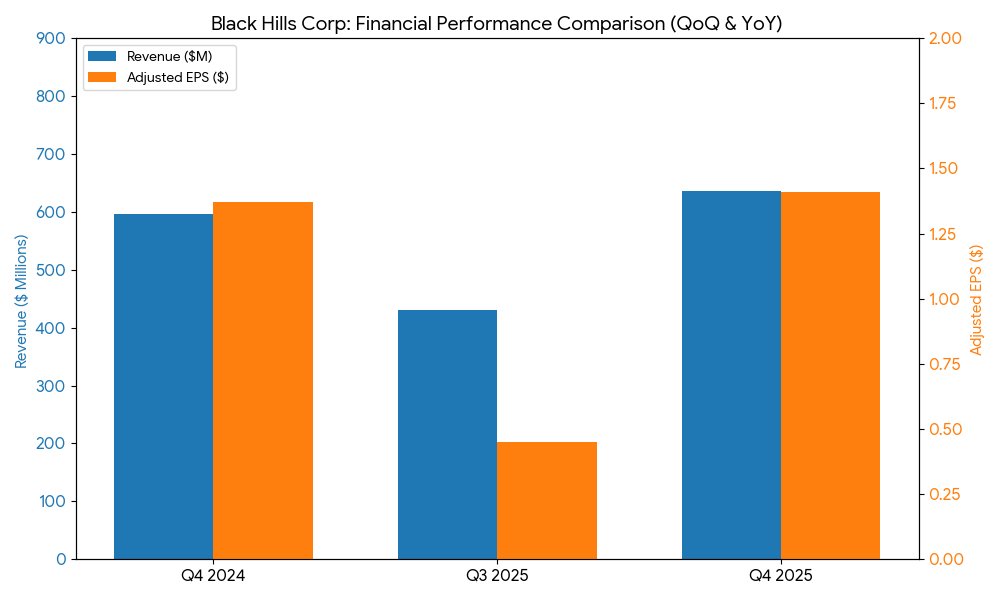
- Q4 2025 Revenue: $635.5 million, missing analyst estimates of $799.1 million. This compared to $597 million in Q4 2024.
- Q4 2025 Earnings: GAAP EPS of $1.39 and adjusted EPS of $1.41, falling short of the $1.45 consensus estimate.
- Full-Year 2025 Performance:
- GAAP EPS: $3.98 (vs. $3.91 in 2024).
- Adjusted EPS: $4.10, a 5% increase year-over-year.
- Dividends: The board approved a quarterly dividend of $0.703, an increase from the previous $0.68, marking 56 straight years of increases.
Forecasts and Sector Pressures
- 2026 Guidance: The company initiated adjusted EPS guidance of $4.25 to $4.45, representing approximately 6% growth over 2025.
- Growth Drivers: Growth is expected from a $3.5 billion five-year capital plan, including a pipeline of 3 GW of data center demand.
- Macro Pressures: The utility sector faces headwinds from higher financing and depreciation costs. Black Hills specifically noted unplanned generation outages and higher operating and maintenance (O&M) expenses as specific challenges in the recent quarter.
- Geopolitical/Tariff Risk: While largely a domestic utility, the company faces indirect risks from potential tariffs on electrical components and transformer equipment, which could inflate infrastructure costs.
SWOT Analysis
| Strengths | Weaknesses |
| 56 consecutive years of dividend increases. | Higher-than-expected O&M and financing costs. |
| Strong regulated asset base and rider recovery. | Q4 revenue and EPS miss against consensus. |
| Opportunities | Threats |
| 3 GW pipeline of potential data center demand. | Regulatory delays for the NorthWestern merger. |
| Completion of the Ready Wyoming transmission project. | Supply chain inflation for utility infrastructure. |
Sequential and Annual Comparison
The recovery in the fourth quarter was driven by the onset of the heating season and the impact of new rate cases. While the company missed analysts’ top-line estimates for the quarter, it achieved the midpoint of its full-year 2025 guidance.
| Metric | Q4 2024 (YoY) | Q3 2025 (QoQ) | Q4 2025 (Current) |
| Revenue ($M) | 597.0 | 430.2 | 635.5 |
| Adjusted EPS ($) | 1.37 | 0.45 | 1.41 |
| GAAP EPS ($) | 1.37 | 0.45 | 1.39 |
Strategic Outlook
- Merger Activity: Management noted continued discovery progress in its pending merger with NorthWestern Energy, which is central to its long-term strategy for Montana and South Dakota service territories.
- Energy Demand: Wyoming electric demand hit four new all-time peaks in 2025, an increase of 21% over 2024 peaks, largely fueled by industrial and data center growth.
- Capital Intensity: The company plans for a $3.5 billion capital expenditure program through 2030, which analysts expect will necessitate disciplined O&M cost control to meet the 6% annual EPS growth target.