

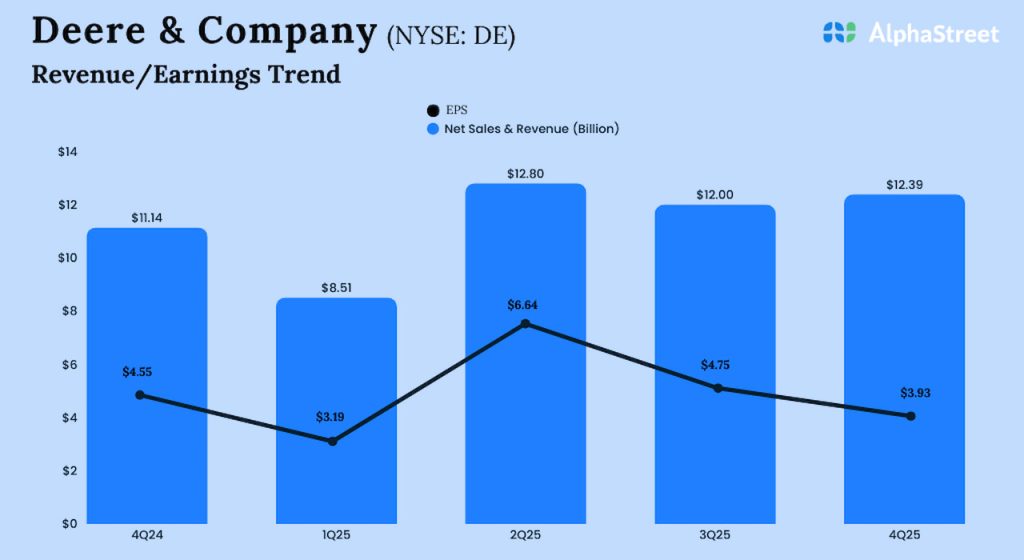
Deere & Company (NYSE: DE), a leading manufacturer of agricultural and construction machinery, has evolved into a technology-driven powerhouse through advancements in its precision agriculture and autonomous systems. Investors and analysts are now closely watching Deere’s upcoming earnings to assess how the company is navigating margin pressures from tariffs and ongoing challenges in the large agricultural equipment market.
What to Expect
The Illinois-based company has scheduled its first-quarter fiscal 2026 earnings release for Thursday, February 19, at 6.25 am ET. It is estimated that Q1 revenues declined approximately 35% year-over-year to $7.5 billion. Analysts’ consensus earnings estimate for the January quarter is $2.1 per share, compared to $3.19 per share in Q1 2025. The company has an impressive track record of outperforming Wall Street’s earnings and revenue estimates.
Deere’s stock has delivered an impressive run recently, reflecting persistent investor interest despite cyclical headwinds. The shares climbed to a new 52-week high this week, extending gains that have outpaced broader market indexes. DE’s total return has significantly outpaced the S&P 500 over the past year, underscoring the stock’s resilience relative to the market. The upbeat performance highlights Deere’s ability to deliver shareholder value through a combination of organic growth and capital returns. It has maintained a consistent dividend growth record, reinforcing investor confidence.
ALSO READ: Highlights of Deere & Company’s Q4 2025 Earnings
Mixed Q4
In the fourth quarter of FY25, Deere’s total sales and revenues increased 11% from the year-ago period to $12.39 billion, reflecting sales growth across all key operating segments. However, Q4 net income declined to $1.06 billion or $3.93 per share from $1.24 billion or $4.55 per share last year. Management said it expects net income to be in the range of $4.00 billion to $4.75 billion in fiscal 2026.
From Deere & Company’s Q4 2025 Earnings Call:
“2025 marked a year of significant challenges and uncertainty, but it also reflected the resilience and strength of the Deere organization, as we continue to demonstrate structurally higher performance levels while making substantial progress on our Smart Industrial journey. Despite the uncertainty, we delivered over $5 billion in net income and we achieved Equipment Operations OROS of 12.6%, which included about 1.5 points impact from tariffs. It’s notable that these income and margin levels surpassed our performance in 2020, the year we launched Smart Industrial despite being at a lower-level point in the cycle this year.”
Innovation
Recognized as a market leader in forestry and farm machinery, Deere maintains its commanding position through continued innovation, brand strength, and deep customer relationships. Farmers leverage these capabilities to optimize yields and reduce input costs. Last year, the company surpassed its digital engagement target, as customers increasingly adopted and expanded their use of its precision farming and automation technologies. Deere leadership is working to improve inventory management and reduce costs as it sees tariff-related cost pressures increasing this year.
Deere’s stock has averaged $487.47 over the past 12 months, with shares up more than one-third so far in 2026. The rally extended this week, and the stock traded notably higher in early Wednesday trading.