
UnitedHealth Group (UNH) is slated to reports its third-quarter results on October 16 before the bell. The largest health insurer in the US is going to announce its results amidst growing political pressure in the country for a universal health care system as health care costs are surging every year along with increasing drug prices.
For the third quarter, analysts expect UnitedHealth’s earnings to be $3.29 per share on revenues of $56.34 billion. For the same period last year, the company’s top line came in at $50.3 billion and adjusted earnings of $2.66 per share. Analysts are expecting a year-over-year growth of 12% and about 24% for revenue and earnings respectively.
It’s worth noting that UnitedHealth kick-started the earnings season for the health insurance industry and its results are viewed as a harbinger by analysts about how its peers like Humana (HUM), Cigna (CI) and Anthem (ANTM) are going to perform this quarter.
With the new health care joint venture floated by three giants Amazon (AMZN), JPMorgan (JPM) and Berkshire (BRK) under the helm of Dr. Atul Gawande, the healthcare industry is expected to see lot of action in the near future, which is going to have an impact on how UNH and other insurers are operating currently.

Two important metrics investors will be interested will be medical costs and medical loss ratio incurred by the insurer. When it comes to medical costs, for the past two quarters, it has climbed up steadily over last year. For the second quarter, it came in at $36.4 billion, increasing 12% over last year.
Related: UnitedHealth Q2 Earnings Call Transcript
Medical loss ratio (MLR) helps investors track how much percentage does the company pay as claims to its users out of the total premium collected. Last quarter the ratio came in at 81.9%, which came in short of analyst consensus. When speaking to analysts in a conference call, CFO John Rex stated that the company expects MLR for 2018 to be in the range of 81.5%, plus or minus 0.50 percentage points.
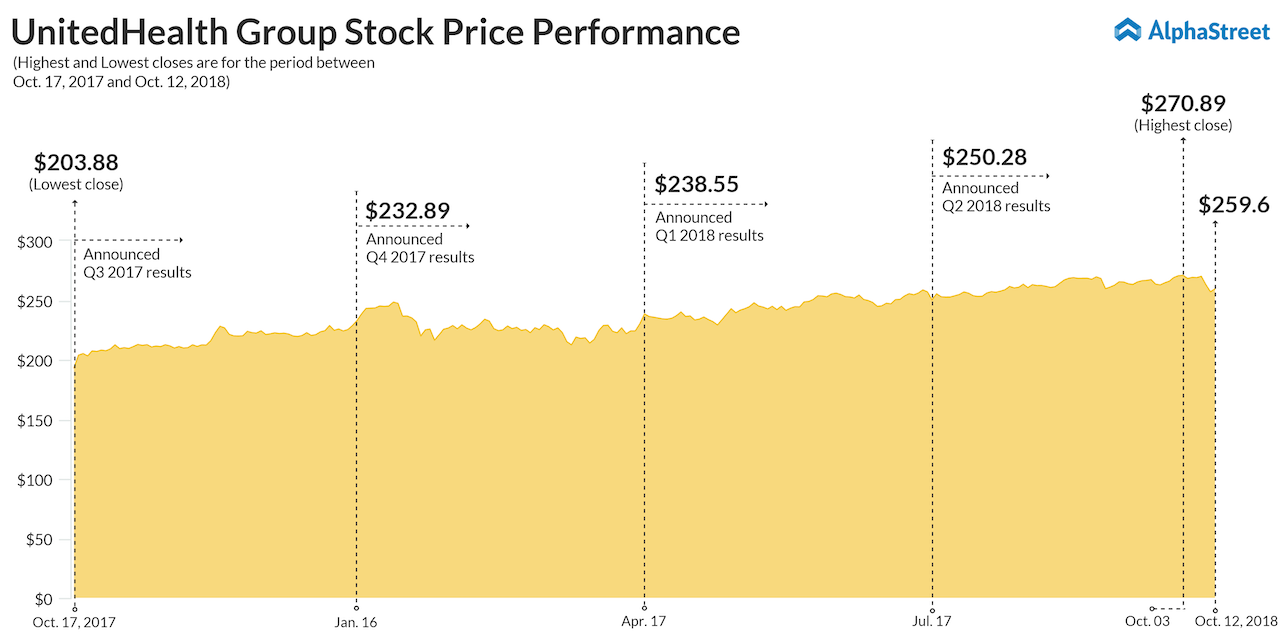
Last quarter, UNH added 2.2 million customers. It would be interesting to see whether the company is able to maintain the net customer additions. In the second quarter, the insurer had also raised its outlook for full-year 2018. It now expects adjusted EPS to be in the range of $12.50 to $12.75 per share. UnitedHealth’s stock has grown above 18% in 2018 and has surged 35% over the last 12 months.