Shares of Financial Institutions, Inc. (NASDAQ: FISI) were trading up about 3% intraday following the release of the company’s fourth-quarter and full-year 2025 financial results, reflecting investor focus on quarterly performance and broader sector trends.
The stock has traded in a roughly $20.97 to $33.73 range over the past 52 weeks, with recent strength supported by improving earnings and a return to profitability.
Quarterly Results
For the quarter ended Dec. 31, 2025, Financial Institutions reported net income of $20.0 million and diluted earnings per share (EPS) of $0.96, compared with a net loss in the year-ago period. After preferred stock dividends, net income available to common shareholders was $19.6 million.
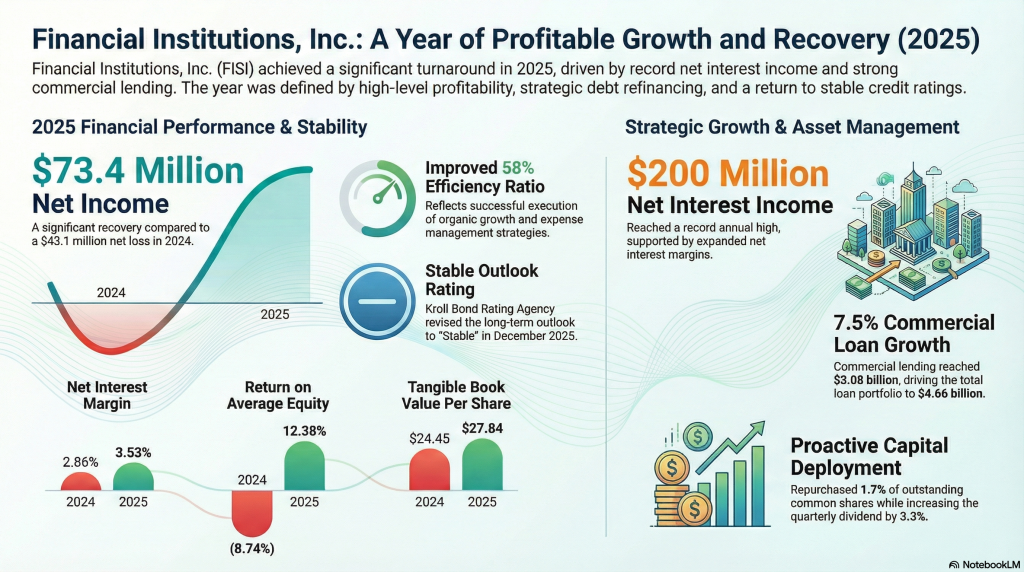
Net interest income reached a quarterly record of $52.2 million, with a net interest margin (NIM) of 3.62%, up significantly year-over-year but down modestly from the prior quarter. Noninterest income was $11.9 million. Total loans ended the quarter at about $4.66 billion, up 4% from a year earlier, driven largely by commercial lending, while deposits stood at $5.21 billion, up around 2% year-over-year.
Margins and Efficiency
The company’s efficiency ratio remained at roughly 58%, signaling disciplined expense management. Net interest margin expansion year-over-year reflected higher yields and disciplined asset mix adjustments. However, the slight sequential decline in margin was attributed to the impact of a subordinated debt issuance in December.
Full-Year Context
For the full year 2025, Financial Institutions reported net income of $74.9 million, or $3.61 per diluted share, reversing a net loss of $41.6 million in 2024. The improvement reflects a broader turnaround in profitability across its core banking, consumer, and wealth management operations. Net interest income for the year reached $200.0 million, up from the prior year, while net interest margin expanded to 3.53%, up nearly 70 basis points. Total loans increased about 4% year-over-year.
Strengths Highlighted
The results underscored several operational strengths. The company achieved positive net income after a loss in the prior year’s quarter, driven by growth in commercial lending and improved net interest margin. The full-year return on average assets (ROAA) and return on equity (ROE) improved, supported by disciplined expense management and organic growth. A successful $80 million private placement of subordinated notes strengthened capital and secured a BBB- rating with a stable outlook from Kroll Bond Rating Agency. The firm also repurchased shares and increased its dividend, indicating confidence in cash flow stability.
Weaknesses and Risks
Despite the overall improvement, certain metrics pointed to challenges. Total deposits were down sequentially, a factor attributed to seasonal flows and reductions in brokered deposits. Net interest margin, though higher year-over-year, slipped slightly from the prior quarter. Noninterest income was stable but lower than the preceding quarter, and modest increases in noninterest expenses were noted. Allowance for credit losses remained elevated relative to historical periods, suggesting ongoing credit quality monitoring.
Sector and Macro Pressures
Financial Institutions’ performance comes amid broader macro pressures affecting regional banks and financial stocks, including interest rate volatility and competitive deposit markets. The banking sector has faced headwinds from tightening credit conditions and slower deposit growth, while tech and SaaS/software stocks have contended with cooling enterprise spending and rising rates. These conditions have contributed to cautious equity valuations across financial and technology sectors.
52-Week Trend
Over the past year, FISI shares have reflected the company’s turnaround narrative, climbing from lows near $21 as profitability improved. The stock’s recent uptrend has coincided with the company’s return to earnings and strategic capital actions, though valuations remain sensitive to broader financial and economic signals.