Share Performance
First Citizens BancShares Inc. (Nasdaq: FCNCA) share has traded in a 52-week range of about $1,474 to $2,413, reflecting volatility around credit, deposit trends, and broader banking sector pressures.
The bank’s stock has generally trended near the upper end of its annual range after posting solid quarterly earnings, though trading volume has been modest and price action has shown some consolidation.
Quarterly Results
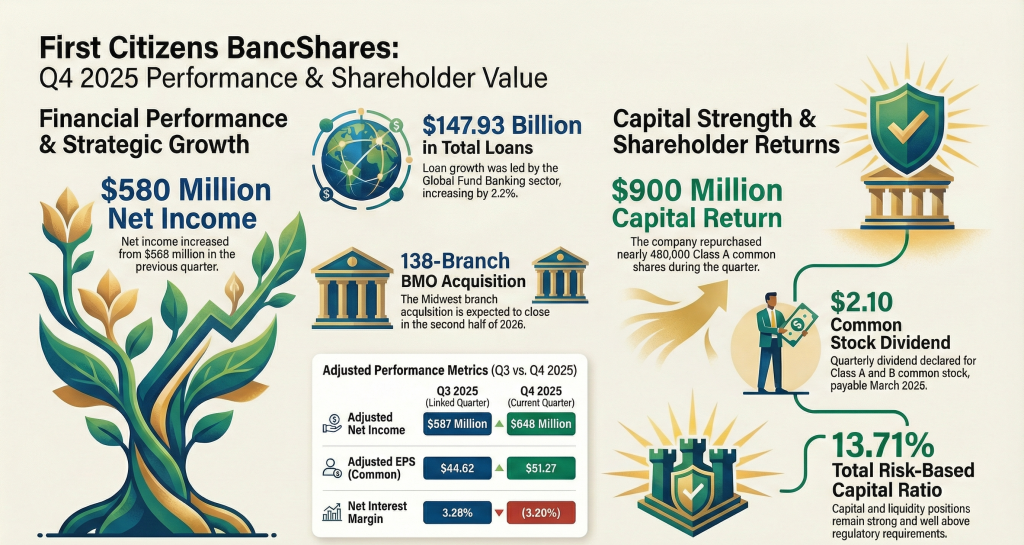
First Citizens reported fourth quarter 2025 net income of $580 million, modestly above the third quarter. Net income available to common stockholders was $566 million, or $45.81 per share, up from $43.08 per share in the prior quarter. Adjusted net income available to common stockholders rose to $634 million, or $51.27 per share.
Net interest income for the quarter was $1.72 billion, slightly lower than the prior quarter, and net interest margin narrowed by 6 basis points to 3.20%. Noninterest income increased modestly, while noninterest expense rose compared with the linked quarter, driven by higher personnel, technology and marketing costs. Loan and lease balances increased to $147.93 billion, while total deposits declined slightly. Provision for credit losses fell from the prior quarter.
The results showed continued loan growth and stable credit quality, but margin compression and higher operating costs weighed on the quarter’s performance.
Dividend Declaration
First Citizens’ board declared a quarterly common stock dividend of $2.10 per share, payable March 16 to holders of record February 27. Preferred stock dividends for Series A, B, C, and newly announced Series D also were declared.
The common dividend increased from the same period last year, reflecting a continuing focus on shareholder returns.
Sector and Macro Pressure
Bank stocks, including First Citizens, are under pressure from broader financial sector trends. Persistently low interest rates and margin compression are challenging net interest income across regional banks, while higher operating costs and technology investments weigh on efficiency ratios. Lending competition and deposit shifts also contribute to sector uncertainty. Broader macro risks, including potential shifts in credit conditions and regulatory expectations, continue to influence investor sentiment.
Outlook and Forward Guidance
Management highlighted its pending BMO branch acquisition expected to close in the second half of 2026, which would add deposits and loans, but noted that ongoing technology and marketing investments are likely to continue into the new year.
The company also signaled continued emphasis on capital return via dividends and share repurchases.