

Company Overview
Knight-Swift Transportation Holdings Inc. is one of North America’s largest freight transportation providers. The company operates a diversified platform that includes full truckload, less-than-truckload (LTL), intermodal, logistics, warehousing, and leasing services, supported by a nationwide terminal network across the United States and Mexico. It operates the largest full truckload fleet in North America and also works with third-party equipment providers.
Third Quarter 2025 Financial Performance
GAAP net income of $7.9 million. Adjusted net income of $51.3 million. GAAP EPS was $0.05, down from $0.19 in Q3 2024. Adjusted EPS was $0.32, slightly down from $0.34 in Q3 2024.
Earnings declined primarily due to significant impairment charges, insurance-related losses, and elevated claims costs.
Revenue and Profitability Highlights
Total revenue was $1.9 billion, up 2.7% year-over-year. GAAP operating income was $50.3 million, down 38.2% YoY. Adjusted operating income was $106.0 million, up 4.2% YoY. GAAP operating ratio was 97.4%. Adjusted operating ratio was 93.8%.
Despite revenue growth, profitability was pressured by non-recurring charges and insurance-related costs.
Guidance (Q4 2025 Outlook)
Adjusted EPS of $0.34 – $0.40. Truckload margins expected to improve sequentially. LTL revenue growth projected at 10–15% YoY. Logistics and Intermodal are expected to show modest sequential improvement. Full-year 2025 capital expenditures estimated at $475–$525 million.
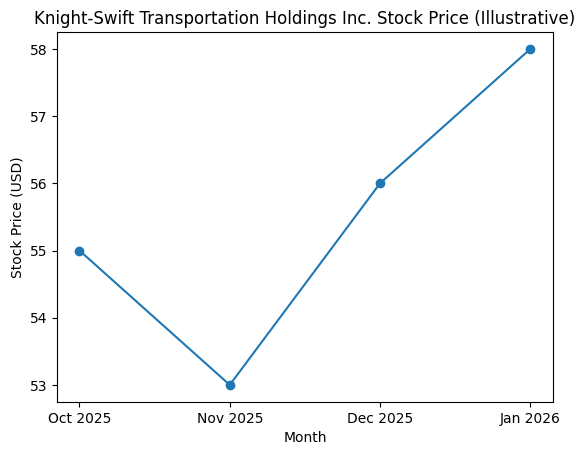
Stock Price Chart
Why an Investor Might Pass on Knight-Swift
1. Weak GAAP Profitability
Despite revenue growth, GAAP earnings dropped sharply, signaling pressure from operational and non-recurring costs.
2. High Exposure to Insurance and Claims Risk
Large claims settlements and insurance-related charges significantly reduced earnings, highlighting ongoing risk from litigation and accidents.
3. Thin Margins in Core Truckload Business
Truckload remains the largest segment but operates with tight margins and declining volumes, limiting upside in a competitive freight market.
4. Elevated Operating Ratio
A consolidated operating ratio near 97% suggests a limited efficiency buffer during economic slowdowns.
5. Cyclical and Capital-Intensive Industry Freight transportation is highly sensitive to economic cycles, fuel costs, and capital expenditures, which may restrict long-term return consistency.