
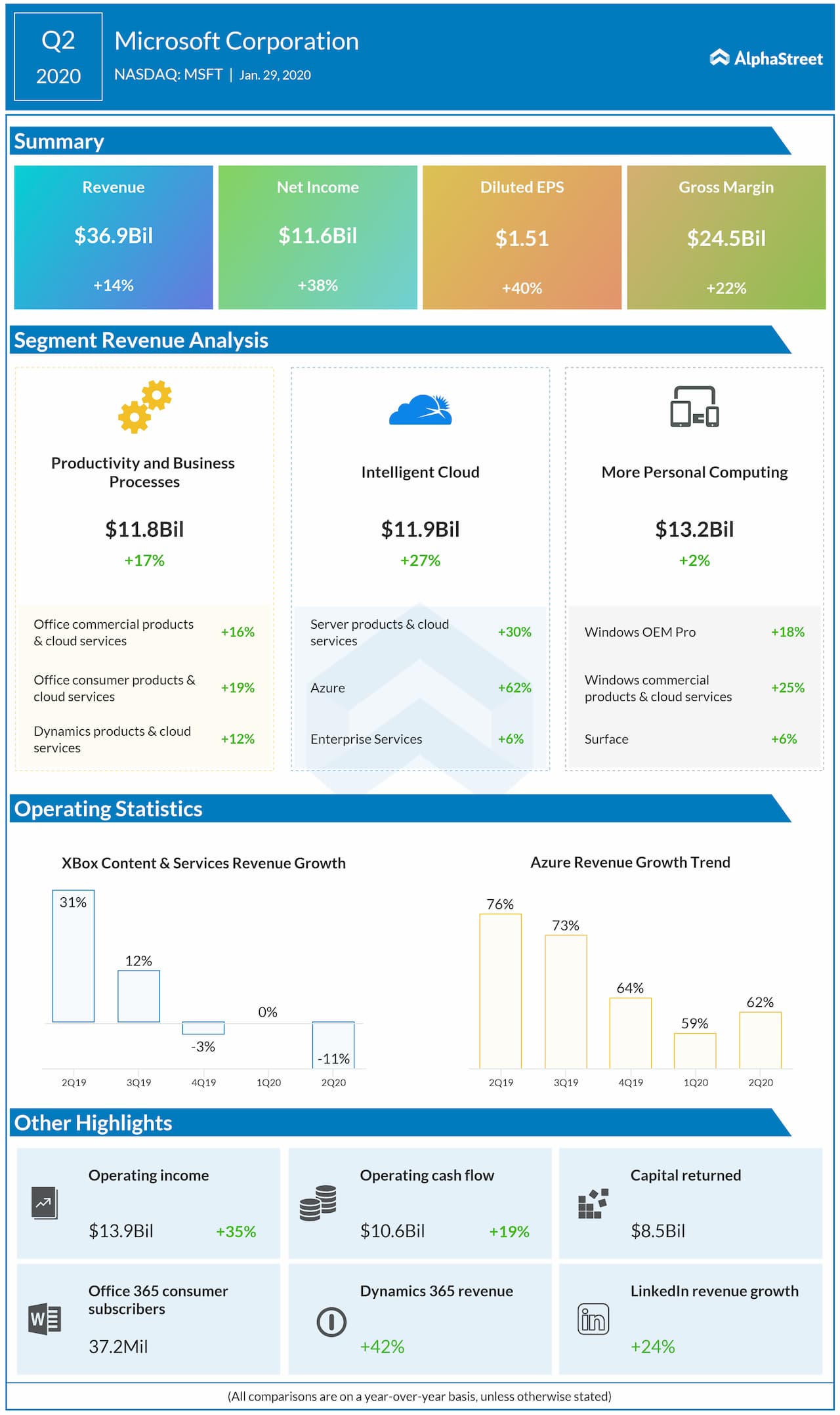
Microsoft Corporation (NASDAQ: MSFT) reported strong quarterly results for Q2 2020 on Wednesday, beating both top and bottom line estimates and recording growth across all its business segments.
The company saw good growth in its cloud business as Azure revenues
increased 62% year-over-year. The momentum in revenues was visible across all
segments with the only dampener being Xbox content and services where revenues
fell 11%.
Looking into the third quarter of 2020, Microsoft expects both consolidated and segment revenues to decrease by around one point due to impacts from foreign currency. The commercial business is expected to see a strong quarter on the back of stable demand for hybrid solutions. Bookings are also expected to grow at a healthy rate.
Gross margins in commercial cloud is expected to improve at
a slower rate than last quarter due to the increasing mix of Azure consumption-based
services. Capital expenditures are estimated to increase due to investments to
support the rising demand.
In the Productivity and Business Processes segment, revenue
is expected to come in the range of $11.5 billion to $11.7 billion, aided by
double-digit growth in Office Commercial, Dynamics and LinkedIn. In the Intelligent
Cloud division, revenue is projected to be $11.85 billion to $12.05 billion.
Enterprise Services revenues are expected to increase slightly from last quarter. More Personal Computing revenues are estimated to be $10.75 billion to $11.15 billion. Windows OEM revenue is expected to grow in the low to mid-single digits, reflecting healthy demand for Windows 10 and end of support for Windows 7.
Also read: Microsoft Q2 2020 Earnings Report
Windows commercial products and cloud services revenue is estimated
to grow in the double digits, helped by strength in Microsoft 365 as well as
benefits from Windows 7 extended support agreements. Surface revenues are
expected to grow in the low single digits.
In Gaming, the company expects the console trend to continue as the launch of Xbox Series X approaches. This, combined with lower transaction volume on a third-party title, is expected to cause revenue to decline in the low double-digit range.
Microsoft’s shares were up 2.6% in afternoon hours on Thursday. The stock has gained 65% over the past one year.