

NBT Bancorp Inc. (NASDAQ: NBTB) announced an 8.8% increase in its quarterly cash dividend to $0.37 per share on January 26, 2026. This declaration marks the thirteenth consecutive year of annual dividend increases for the company. The dividend is payable on March 16, 2026, to shareholders of record as of March 2, 2026.
Business & Operations Update
The company reported a total loan portfolio of $11.60 billion as of December 31, 2025, an increase of 16.3% from the end of 2024. This growth included $1.17 billion in commercial loans and $0.46 billion in consumer loans. Total deposits reached $13.50 billion, up 16.9% year-over-year, with low-cost deposits accounting for 58% of the total base. The board of directors approved a first-quarter 2026 cash dividend of $0.37 per share, an 8.8% increase over the previous year.
M&A or Strategic Moves
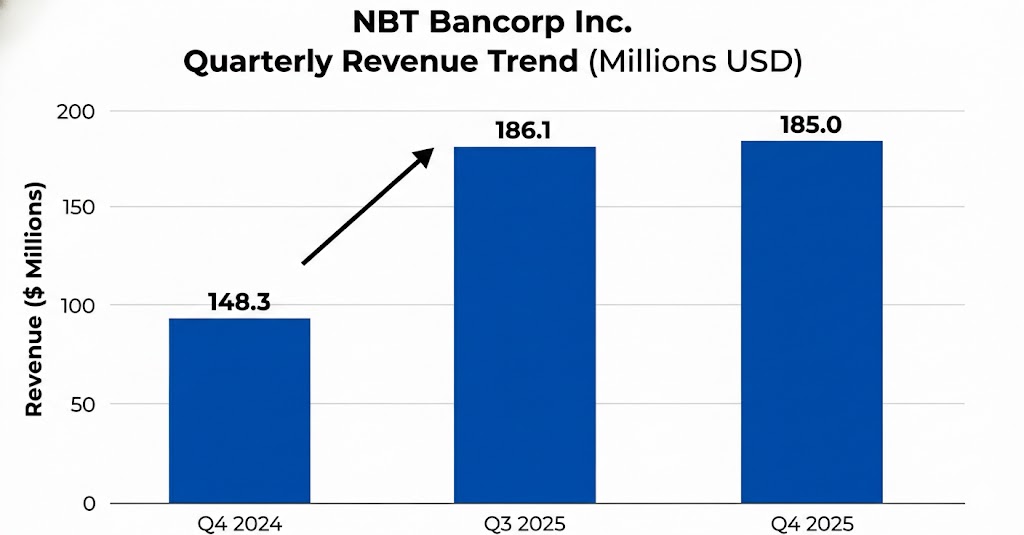
NBT Bancorp completed its merger with Evans Bancorp, Inc. on May 2, 2025. The transaction added 18 banking locations in Western New York, approximately $1.67 billion in loans, and $1.86 billion in deposits to the company’s balance sheet. The integration included a core systems conversion finalized in May 2025.
Financial Trends
Equity Analyst Commentary
Institutional research coverage noted that NBT Bancorp’s earnings per share of $1.06 exceeded consensus expectations of $0.98. Reports from DA Davidson and Janney Montgomery Scott highlighted the 8.16% earnings surprise and the stability of the bank’s net interest margin, which stood at 3.65% on a fully taxable equivalent basis. Analysts at Piper Sandler cited the growth in tangible book value per share, which rose 11% to $26.54.
Guidance & Outlook
Management has issued guidance for 2026, projecting loan growth in the mid-to-lower single-digit range. The company expects a modest expansion in net interest margin of 2 to 3 basis points per quarter, depending on yield curve movements. The solar loan portfolio is anticipated to reduce by approximately $100 million annually.