

PACCAR Inc. (NASDAQ: PCAR) on Tuesday reported its 87th consecutive year of profitability, bolstered by record-breaking performances in its parts and financial services divisions, even as broader industry headwinds and a one-time legal charge weighed on annual consolidated net income.
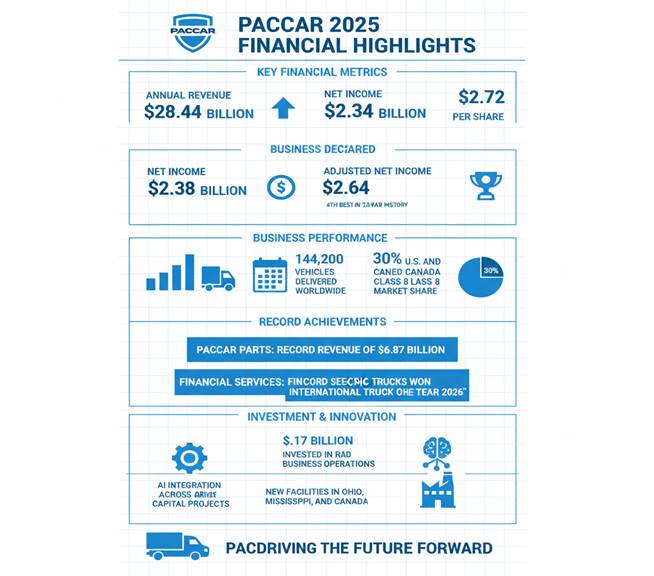
The manufacturer of Kenworth, Peterbilt, and DAF trucks reported full-year 2025 consolidated revenues of $28.44 billion, down from the record $35.13 billion achieved in 2024. Net income for the year stood at $2.38 billion, or $4.51 per diluted share.
Excluding a non-recurring after-tax charge of $264.5 million related to civil litigation in Europe, PACCAR achieved an adjusted net income of $2.64 billion ($5.01 per share). Despite the year-over-year decline, the results represent the fourth-highest annual profit in the company’s 120-year history.
Service Segments Drive Resilience
While truck deliveries slowed in line with a cooling global freight market, PACCAR’s high-margin segments reached new heights. PACCAR Parts achieved record annual revenues of $6.87 billion, a 3% increase over 2024. PACCAR Financial Services also hit a milestone, with annual revenues climbing to a record $2.21 billion and pretax income rising 11% to $485.4 million.
“PACCAR reported very good annual revenues and net income in 2025,” said Chief Executive Officer Preston Feight. “Our results reflect the structural strength of our parts and financial services businesses, which continue to provide excellent performance throughout the business cycle.”
For the fourth quarter ended Dec. 31, revenues reached $6.82 billion compared to $7.91 billion in the same period last year. Quarterly net income was $556.9 million, or $1.06 per share, matching analyst expectations but falling from $872.0 million a year ago.
Market Position and Operational Highlights
PACCAR delivered 144,200 vehicles worldwide in 2025. In the critical U.S. and Canada Class 8 market, the company maintained a strong 30% retail sales market share.
The year was also marked by several industry accolades and sustainability milestones:
- DAF XD and XF Electric trucks were named “International Truck of the Year 2026,” marking the third time in five years a PACCAR brand has received the honor.
- The company earned an “A” rating from CDP for climate disclosure, placing it in the top tier of environmental transparency.
- PACCAR was recognized as a “Top Company for Women to Work for in Transportation” by the Women in Trucking Association.
Strategic Outlook and Policy Clarity
Management expressed optimism for 2026, citing newfound clarity regarding trade and environmental policies. PACCAR noted that its localized manufacturing footprint in the United States, Canada, and Mexico positions it favorably under the Section 232 truck tariff policy that took effect in late 2025.
For 2026, PACCAR estimates U.S. and Canada Class 8 industry retail sales will be in a range of 230,000 to 270,000 units, as stabilizing freight conditions and economic growth are expected to improve customer demand. The European heavy-duty market is projected at 280,000 to 320,000 registrations.
To maintain its competitive edge, the company plans to increase its investment in future technologies. Capital expenditures for 2026 are projected between $725 million and $775 million, with research and development (R&D) spending estimated at $450 million to $500 million. These funds are earmarked for next-generation clean diesel, electric, and autonomous vehicle platforms.
Shareholder Returns
Reflecting its strong cash position, PACCAR declared total cash dividends of $2.72 per share during 2025. This included a regular quarterly dividend and a $1.40 per share year-end extra dividend, which was paid to shareholders in early January 2026. As the industry prepares for the transition to EPA 2027 NOx emissions standards, PACCAR’s leadership signaled that the company is well-prepared to navigate the shifting regulatory landscape. “We look forward to 2026 being a year of growth for our customers and PACCAR,” Feight concluded.