Categories AlphaGraphs, Earnings, Leisure & Entertainment
PLAY Earnings: Dave & Buster’s Q2 2024 profit rises on higher revenues
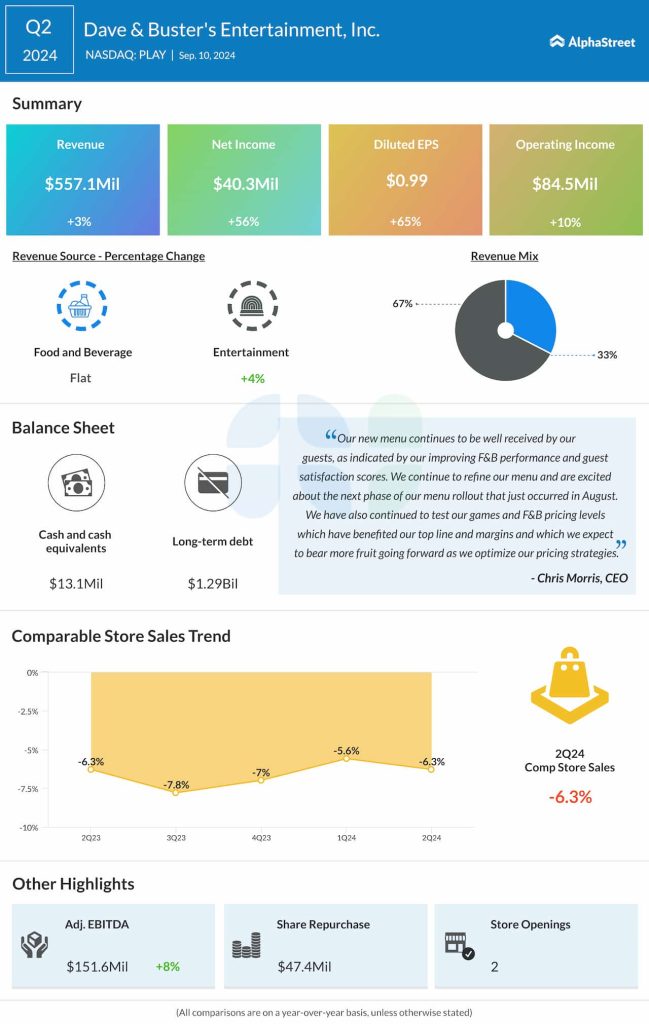
Dave & Buster’s Entertainment, Inc. (NASDAQ: PLAY), which operates a chain of casual dining and leisure facilities, has reported an increase in revenues and net income for the second quarter of 2024.

The Dallas-based company reported a net income of $40.3 million or $0.99 per share for the July quarter, higher than the $25.9 million or $0.60 per share recorded in the prior-year period. Adjusted EBITDA increased 8% annually to $151.6 million during the three months.
Driving the bottom line growth, second-quarter revenues rose 3% year-over-year to $557.1 million, even as comparable store sales declined 6.3%. Entertainment revenue grew 4%, while Food and Beverage revenue remained unchanged.
Chris Morris, the company’s CEO, said, “During the quarter, we grew Revenue and Adjusted EBITDA, expanded our Adjusted EBITDA margins and generated strong operating cash flow which allowed us to invest in the business and return cash to shareholders.”
Prior Performance
Listen to the conference calls as they happen. Don't miss a beat! With AlphaStreet Intelligence, you can listen to live calls and interviews as they happen, so you never have to worry about missing out on important information.
Most Popular
Intuit (INTU) set to report Q1 FY26 results. Here’s what to expect
Intuit Inc. (NASDAQ: INTU) is preparing to report results for the first three months of fiscal 2026, amid expectations for a double-digit increase in revenues and adjusted earnings. While the
Estee Lauder’s (EL) Beauty Reimagined strategy is paying off, a few points to note
Shares of The Estée Lauder Companies Inc. (NYSE: EL) stayed green on Friday. The stock has gained 20% year-to-date. After going through a challenging phase, the company witnessed a rebound
Omnichannel push, margin dynamics in focus as Walmart gears up for Q3 earnings
Walmart Inc. (NYSE: WMT) entered the second half of FY26 navigating a challenging retail landscape marked by tariff-related cost pressure and cautious consumer behavior. At the same time, the company
