

Roivant Sciences (Nasdaq: ROIV) reported its financial results for the fiscal third quarter ended December 31, 2025, underscored by positive Phase 2 clinical data for its lead inflammation and immunology candidate, brepocitinib. While the company experienced a widening net loss due to intensified research and development activities, its significant cash position of $4.5 billion remains a focal point for investors as it approaches multiple pivotal readouts.
Clinical Breakthrough in Cutaneous Sarcoidosis
The quarterly update was highlighted by topline results from the BEACON study, a Phase 2 placebo-controlled trial evaluating brepocitinib in patients with cutaneous sarcoidosis (CS), a condition with no currently approved therapies. The study successfully met its primary efficacy goals, demonstrating deep clinical benefit.
Key findings from the Phase 2 BEACON study included:
- Efficacy Metrics: The 45 mg dose of brepocitinib achieved a placebo-adjusted mean improvement of 21.6 points on the Cutaneous Sarcoidosis Activity and Morphology Instrument-Activity (CSAMI-A) score ($p<0.0001$).
- Response Rates: 100% of participants in the 45 mg arm reached at least a 10-point improvement in CSAMI-A, compared to 14% for the placebo group.
- Remission and Clearance: Functional remission ($CSAMI-A < 5$) was achieved by 62% of patients in the 45 mg group, while 69% reached “Clear” or “Almost Clear” status on the Investigator’s Global Assessment (IGA) scale.
- Safety Profile: The treatment was well-tolerated over 16 weeks, with no serious adverse events (SAEs) reported.
Based on these results, Roivant’s subsidiary, Priovant, intends to initiate a Phase 3 pivotal program for CS by the end of calendar year 2026.
Fiscal Q3 Financial Results
Roivant’s financial performance for the quarter reflected the capital-intensive nature of its transition into late-stage drug development. The company reported a net loss from continuing operations of $313.7 million, or $0.38 per share, compared to $208.9 million in the prior-year period.
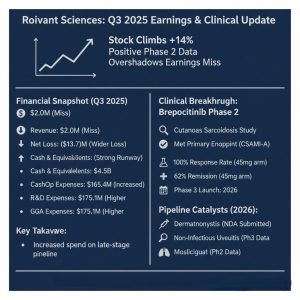
Three Months Ended December 31, 2025 (Select Metrics)
- Research and Development (R&D): Expenses grew to $165.4 million from $141.6 million, primarily driven by clinical trial progression. Adjusted R&D expenses (non-GAAP) were $146.7 million.
- General and Administrative (G&A): Expenses rose to $175.1 million from $141.5 million, though adjusted G&A remained stable at $71.0 million.
- Adjusted Net Loss: On a non-GAAP basis, the net loss from continuing operations was $167.0 million.
The company concluded the quarter with approximately $4.5 billion in cash, cash equivalents, and marketable securities. Management noted that this liquidity, combined with no debt, provides the runway necessary to execute on its multi-year strategy.
Forward Strategy and Industry Outlook
Roivant is positioning itself for a “catalyst-rich” 2026, with major data readouts expected across its “Vant” subsidiaries. The company’s model focuses on decentralized drug development, which allows for parallel advancement of multiple high-value programs.
Upcoming milestones include:
- Brepocitinib: Topline Phase 3 data in non-infectious uveitis (NIU) is anticipated in the second half of 2026.
- IMVT-1402: Potentially registrational data in difficult-to-treat rheumatoid arthritis is expected in the second half of 2026.
- Mosliciguat: Phase 2 data for pulmonary hypertension associated with interstitial lung disease (PH-ILD) is also slated for the latter half of 2026.
Additionally, Roivant is moving toward a jury trial in its U.S. litigation against Moderna regarding lipid nanoparticle (LNP) technology, scheduled for March 2026. A recent favorable summary judgment has affirmed the company’s view that a significant portion of potential liability belongs with Moderna.
In the broader context of the biotechnology sector, Roivant’s performance is being watched as a bellwether for the “Vant” business model. While the company continues to report substantial quarterly losses, its success in advancing orphan indications like cutaneous sarcoidosis suggests a viable path toward commercialization and long-term shareholder value.