
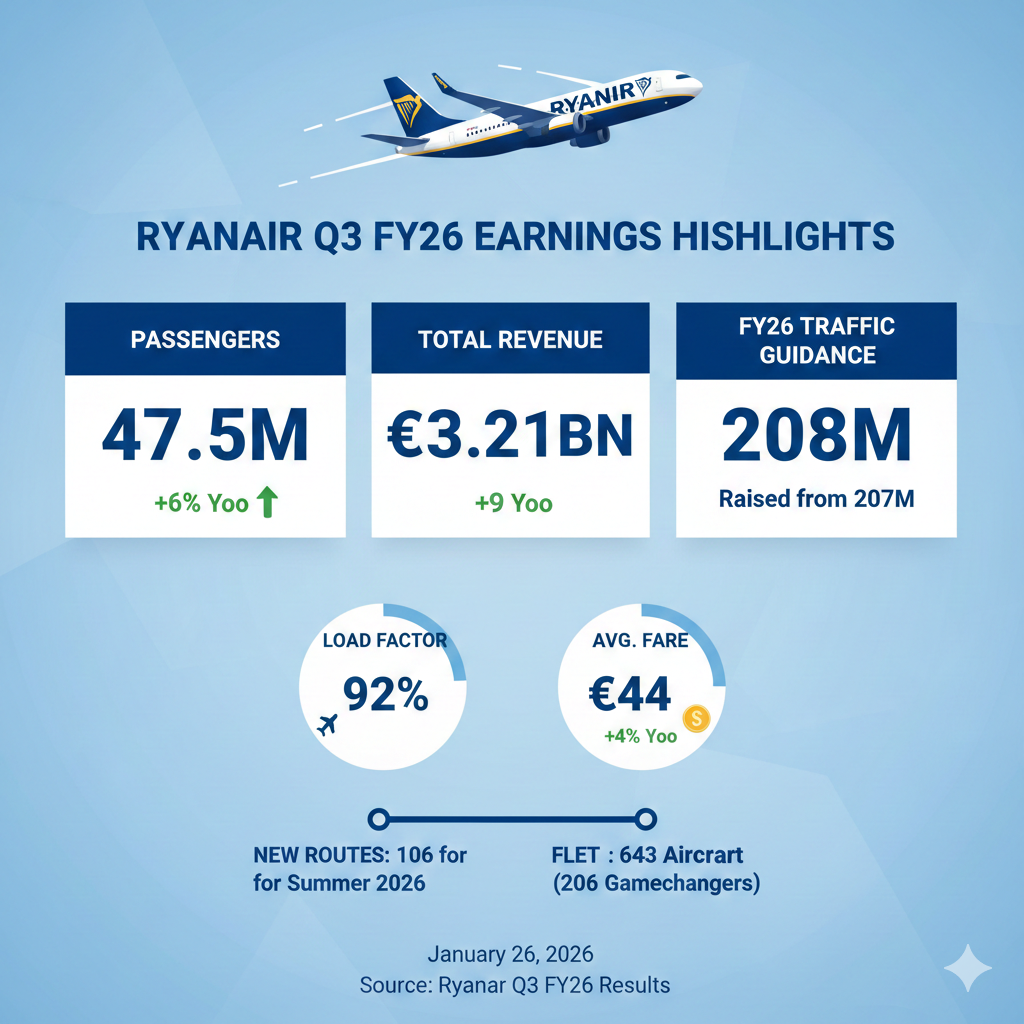
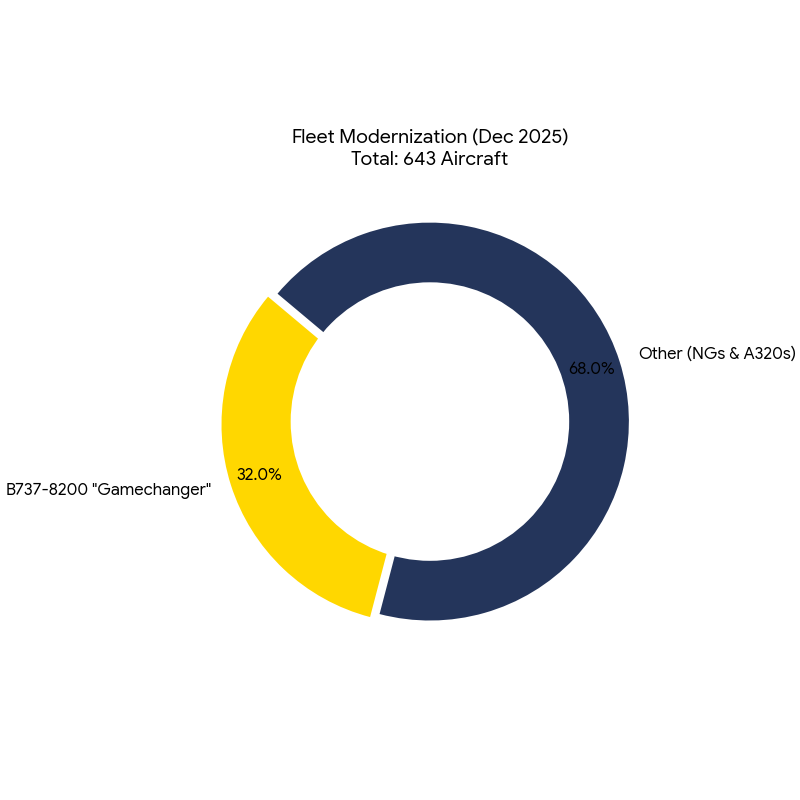
Ryanair Holdings plc (RYAAY – NASDAQ) is Europe’s largest low-cost airline, headquartered in Dublin, Ireland. Since its founding in 1984, Ryanair has grown to operate over 640 aircraft across 200+ destinations in 40+ countries. The airline’s business model combines structural cost advantages, high aircraft utilization, and ancillary revenue streams, allowing it to sustain profitability even in competitive European short-haul markets. Its fleet includes 206 next-generation Boeing 737 “Gamechanger” aircraft, which improve fuel efficiency and reduce maintenance costs.
Operational Highlights and Passenger Trends
Ryanair’s Q3 FY26 performance underscores resilience in European short-haul travel. Passenger traffic increased year-on-year, reflecting strong demand across leisure and business segments. Load factors remained exceptionally high, demonstrating the airline’s ability to maintain operational efficiency while expanding capacity.
Key operational metrics include:
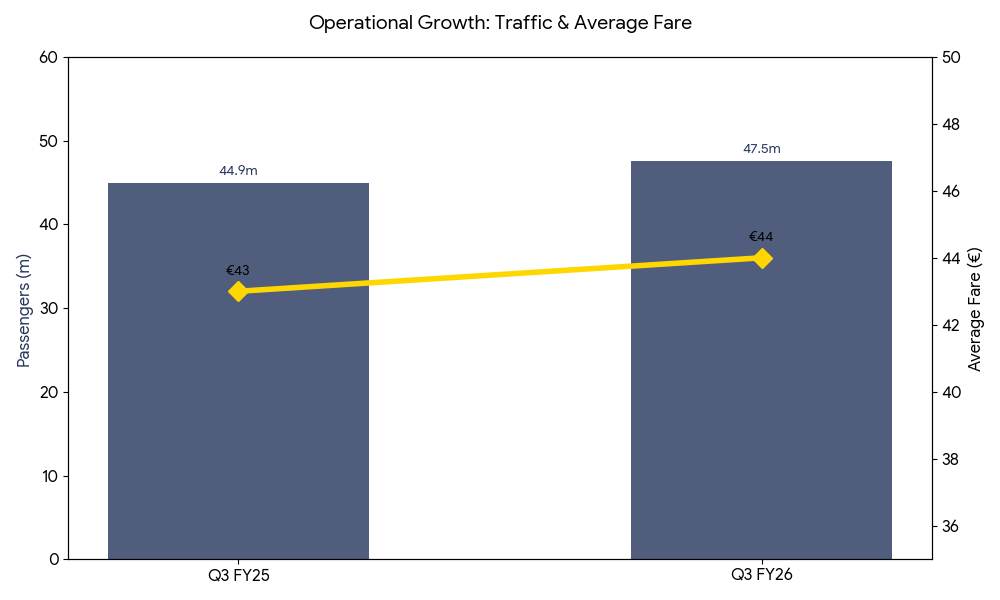
- Passenger numbers increased by ~6% to 47.5 million
- Load factor sustained at 92%, one of the highest in European aviation
- Average fares increased by ~4%, contributing to ~9% revenue growth
These figures reflect robust late-booking trends during peak holiday periods and indicate that Ryanair’s low-cost proposition continues to attract price-sensitive travelers while allowing incremental revenue capture.
Revenue and Profitability Analysis
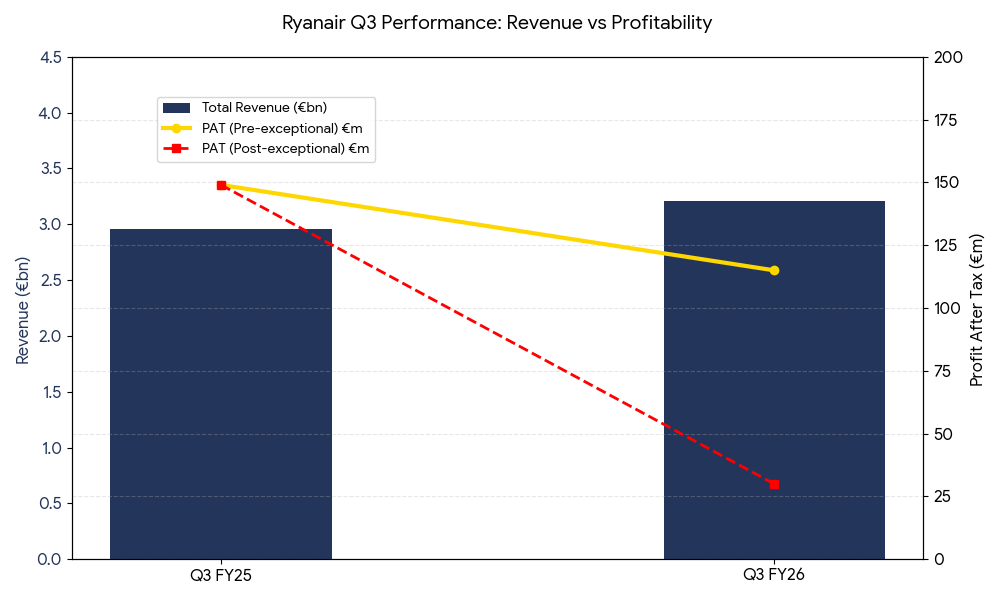
Revenue growth was strong; however, profit performance was affected by external and exceptional factors. Pre-exceptional profit after tax declined by 22%, driven by rising operating costs, including fuel, airport charges, and staffing. Post-exceptional profit was materially reduced due to a €85 million provision related to an Italian competition authority fine.
Despite these challenges, Ryanair’s underlying operational efficiency remains a key differentiator:
- Unit costs per passenger (excluding fuel) remained broadly stable
- Ancillary revenue growth, though slightly slower than fares, continues to enhance overall profitability
- Fleet standardization and high utilization underpin cost leadership
This demonstrates that Ryanair’s operating model is resilient, with exceptional items being the main driver of volatility in reported earnings.
Fleet, Network, and Capacity Management
Fleet strategy and network deployment remain central to Ryanair’s competitive advantage. The airline continues to modernize its fleet with fuel-efficient Boeing 737 “Gamechanger” aircraft, improving per-seat operating costs and reducing environmental impact. Network planning focuses on high-demand routes while optimizing frequency to maintain load factors and maximize yield.
Ryanair’s approach to ancillary revenue complements capacity growth, monetizing services such as baggage, priority boarding, and digital offerings to generate incremental income per passenger. This dual strategy—efficient network and diversified revenue streams—strengthens the airline’s operational and financial resilience.
Balance Sheet and Liquidity Position
Ryanair’s balance sheet remains robust, providing flexibility for growth and shareholder returns. Key points:
- Gross cash of €2.4 billion; net cash around €1 billion
- Debt reduced by €1.2 billion, enhancing leverage metrics
- Undrawn revolving credit facilities provide an additional €1 billion of liquidity
The company maintains investment-grade ratings (BBB+) and continues to return capital to shareholders through dividends and buybacks. Nearly half of its €750 million buyback program has been executed, and an interim dividend of €0.193 per share was declared, highlighting confidence in cash flow generation.
Strategic Position and Competitive Advantage
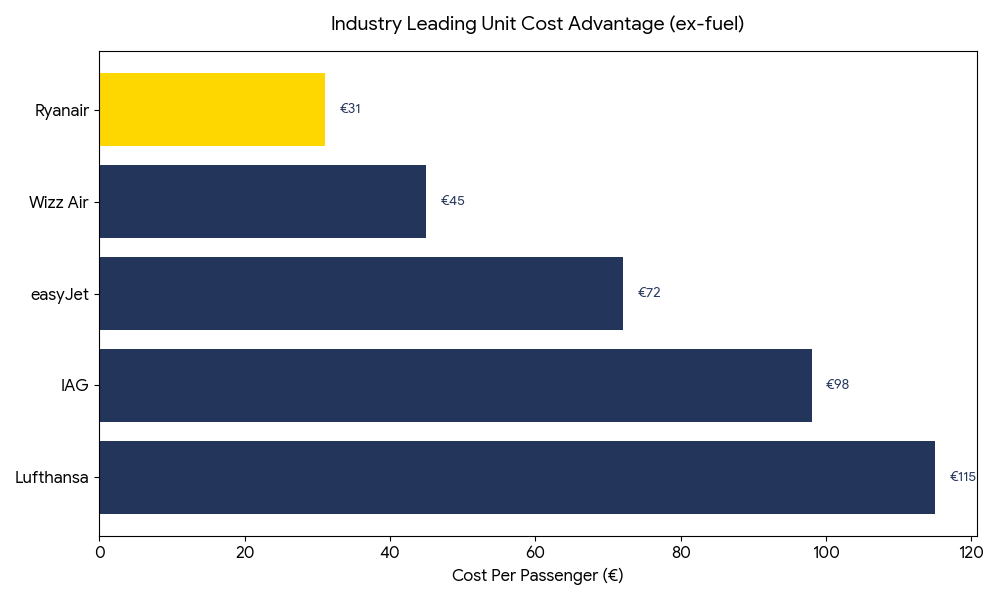
Ryanair’s low-cost structure continues to provide a significant competitive edge:
- One of the lowest unit costs per passenger in Europe
- High operational efficiency through fleet standardization and route optimization
- Ancillary revenue and digital platform monetization improve profitability per passenger
These factors enable Ryanair to absorb cost pressures, maintain fare competitiveness, and sustain profitability even under macroeconomic uncertainty.
Fuel and Cost Hedging
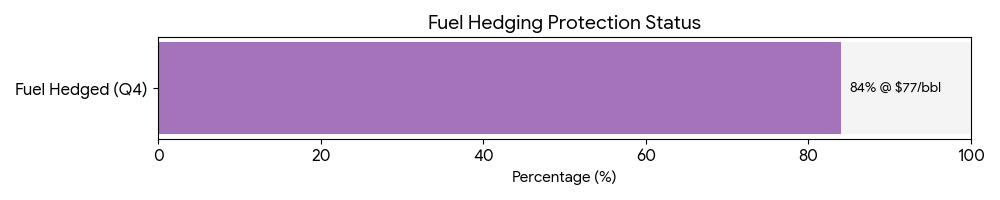
Fuel price volatility is a key risk for airlines, and Ryanair’s hedging strategy mitigates this:
- Approximately 80% of FY27 fuel requirements hedged at ~$67 per barrel
- Hedging reduces exposure to sudden fuel price increases and supports predictable operating margins
This disciplined approach to cost management is critical in maintaining the airline’s low-cost leadership and long-term financial stability.
Forward Outlook
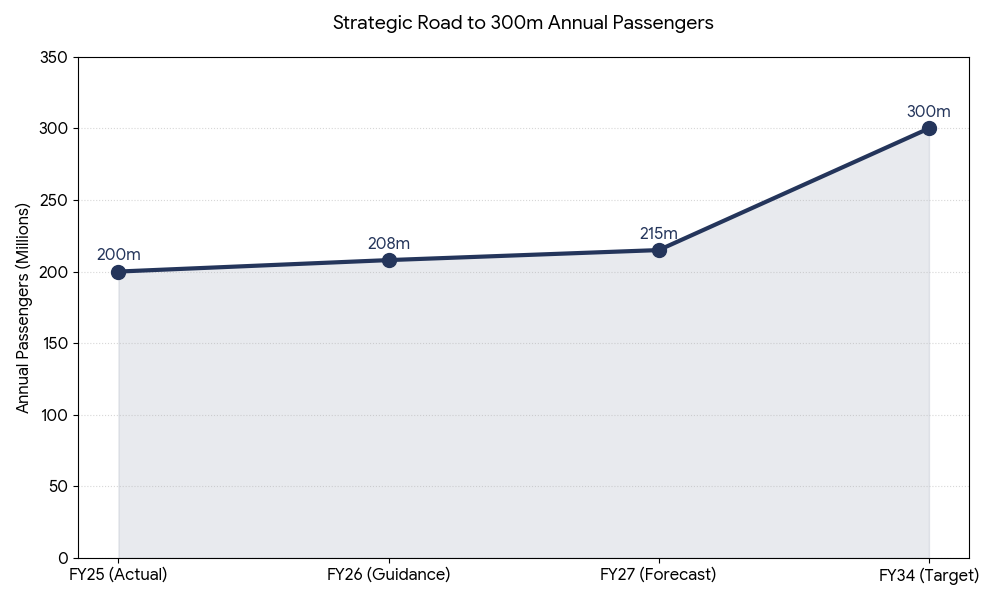
Ryanair projects full-year passenger traffic growth of ~4% to around 208 million passengers, with fares expected to continue rising due to strong seasonal demand. Pre-exceptional profit after tax for FY26 is forecast between €2.13 billion and €2.23 billion, reflecting confidence in underlying operational performance despite regulatory and macroeconomic headwinds.
Strategic priorities include:
- Continued fleet expansion and modernization
- Network optimization to balance load factors and yields
- Enhanced digital and ancillary revenue channels
These initiatives are designed to reinforce Ryanair’s cost leadership and long-term market position while sustaining profitability.
Expert Analysis
Ryanair’s Q3 FY26 results illustrate the strength of its low-cost operating model and strategic positioning. Passenger growth, high load factors, and unit cost stability support revenue and operational resilience. Exceptional items, primarily regulatory charges, are the main source of near-term volatility in reported profits.
From an investment perspective, Ryanair offers structural advantages as a European low-cost carrier with strong cash flows, shareholder-friendly policies, and defensible operational metrics. Earnings may remain sensitive to regulatory and macroeconomic developments, but the airline’s strategic initiatives and robust balance sheet provide a solid foundation for long-term performance.
Bottom Line
Ryanair continues to demonstrate resilience and strategic discipline in a competitive European airline market. Key takeaways:
- Strong passenger growth and sustained load factors validate demand resilience
- Revenue growth and ancillary monetization support profitability despite external pressures
- Cost leadership and fleet modernization provide a competitive moat
- Robust balance sheet and shareholder-friendly policies enhance financial flexibility
- Exceptional items and regulatory risks remain near-term earnings headwinds, but underlying operations remain robust
Overall, Ryanair is well-positioned to maintain market leadership, generate solid cash flows, and navigate the evolving European aviation landscape effectively.