
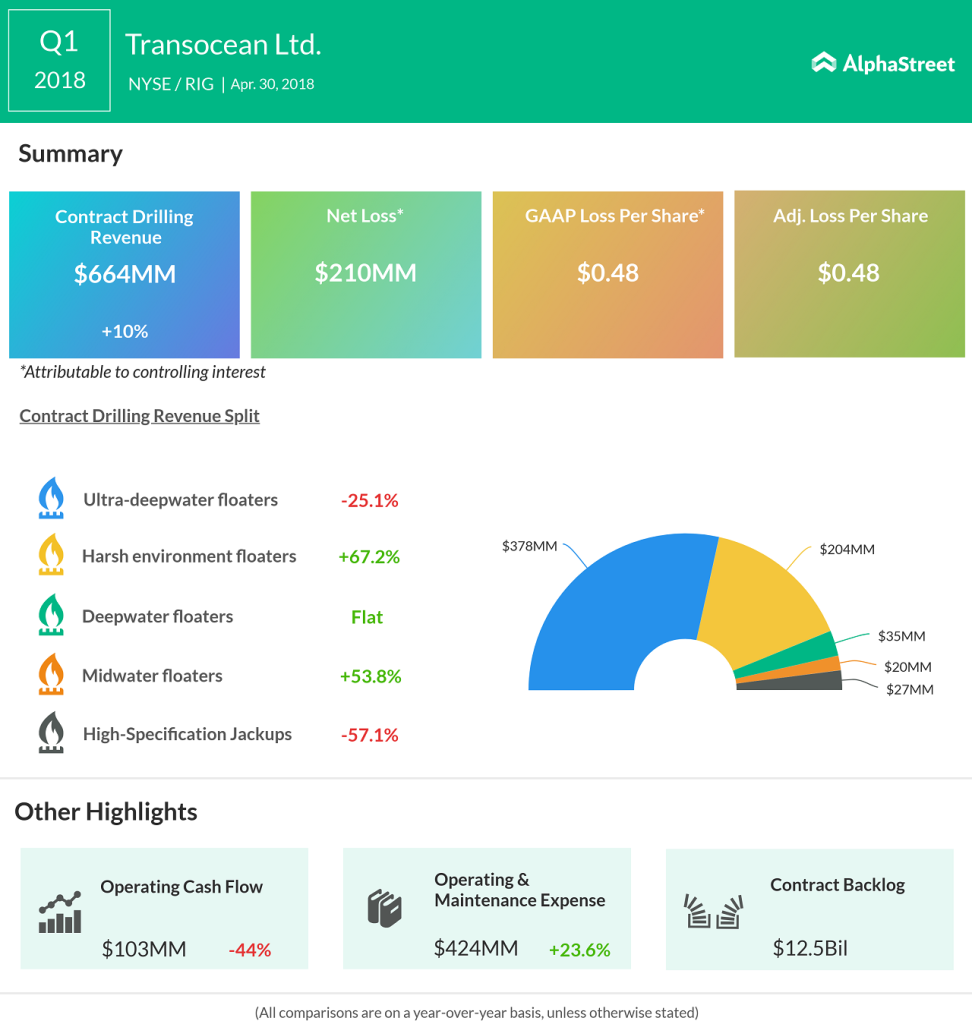
Transocean Ltd (RIG) continued its losing streak that began nearly a year ago and posted a wider than expected loss in the first quarter even as the company struggles to sustain operational efficiency by upgrading its aging floater fleet. Revenues came in above estimates during the quarter, despite registering a decline.
Transocean’s shares dipped more than 2% in the after-hours trading session following the unimpressive earnings report, continuing the day’s trend. In April, the stock had gained nearly 27%.

The Switzerland-based offshore drilling company, which has its U.S. operations headquartered in Houston, stayed in the negative territory for the fourth consecutive quarter, posting a loss of $0.48 per share in the first three months of 2018 compared to earnings of $0.23 per share last year. Analysts had forecasted a narrower loss.
Contract drilling revenues declined 10% annually to $664 million during the quarter, hurt by softness in drilling activities involving ultra-deepwater floaters, Transocean’s revenue-driving segment. The company had combined contract backlog of $12.5 billion at the end of the quarter.
Contract drilling revenues declined 10% annually to $664 million during the first quarter
“We consummated the Songa Offshore acquisition, which added four new, contracted, high‑specification, harsh environment semisubmersibles to our fleet, and further bolstered our industry-leading backlog,” said Transocean CEO Jeremy Thigpen.
Though the Songa acquisition and deployment of a new drillship contributed to offshore activities during the quarter, they were offset by reduced operating days and lower revenue efficiency of some rigs.
Looking ahead, the company expects stable oil prices, lower project breakeven economics and low global reserve replacement will drive demand for its products and services.
Transocean’s competitor Diamond Offshore Drilling (DO) reported an adjusted net loss of $0.16 per share for the first quarter, compared to a $0.19 per share loss analysts had projected. Halliburton (HAL) posted a 34% growth in revenues for its most recent quarter.