
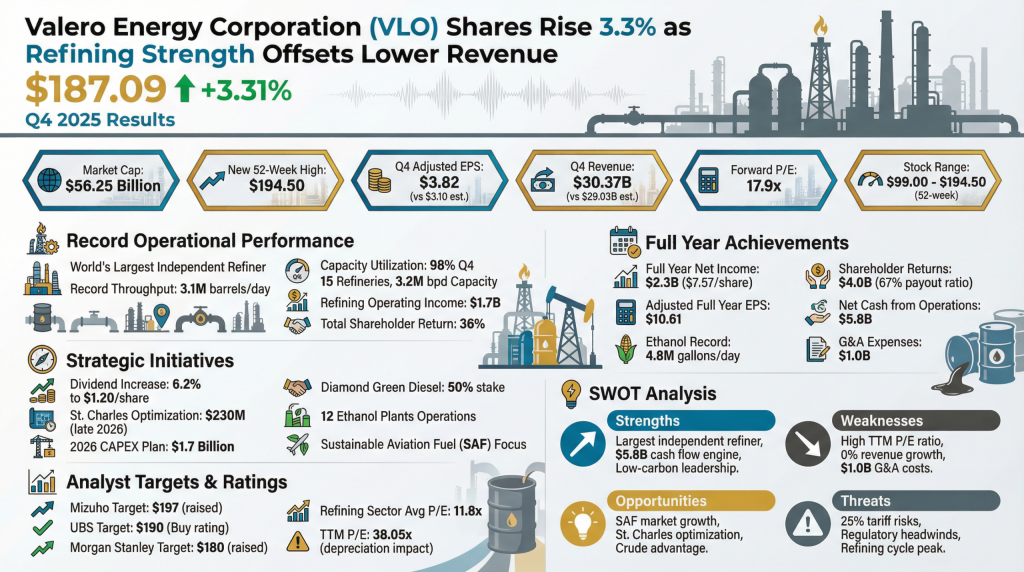
Strengths
- Operational Scale: Largest independent refiner globally with record 98% throughput capacity utilization in Q4.
- Cash Flow Engine: $5.8 billion in net cash from operating activities in 2025 supports a 67% shareholder payout ratio.
- Low-Carbon Pivot: Market leadership in renewable diesel through Diamond Green Diesel provides a hedge against traditional fuel demand shifts.
Weaknesses
- Margin Compression: GAAP margins are sensitive to high non-cash depreciation charges, leading to a high TTM P/E ratio.
- Revenue Stagnation: Full-year revenue growth was flat at 0% year-over-year despite record volumes.
- Operating Costs: G&A expenses rose to $1.0 billion in 2025, driven by labor and integration costs.
Opportunities
- SAF Market Entry: Growing mandates for Sustainable Aviation Fuel (SAF) offer high-margin growth in the renewables segment.
- Strategic Optimization: The St. Charles FCC project is expected to deliver incremental yield improvements by late 2026.
- Crude Advantage: Ability to leverage widening sour crude discounts to lower feedstock costs.
Threats
- Trade Protectionism: Potential 25% tariffs on imported industrial inputs could inflate the cost of the $1.7 billion CAPEX plan.
- Regulatory Headwinds: Evolving RFS and RVO policies could impact the profitability of the ethanol and renewable diesel segments.
- Refining Cycle Peak: Risk of a “down-cycle” in refining margins if global economic growth slows and fuel demand softens.