
It’s that time of the year when retailers rejoice and customers shop till they drop. As usual, two big-box retailers – Walmart (WMT) and Target (TGT) – will be looking to bag the most significant share of the holiday purchases. But on closer inspection, Target seems like a better investment this quarter than its bigger rival.
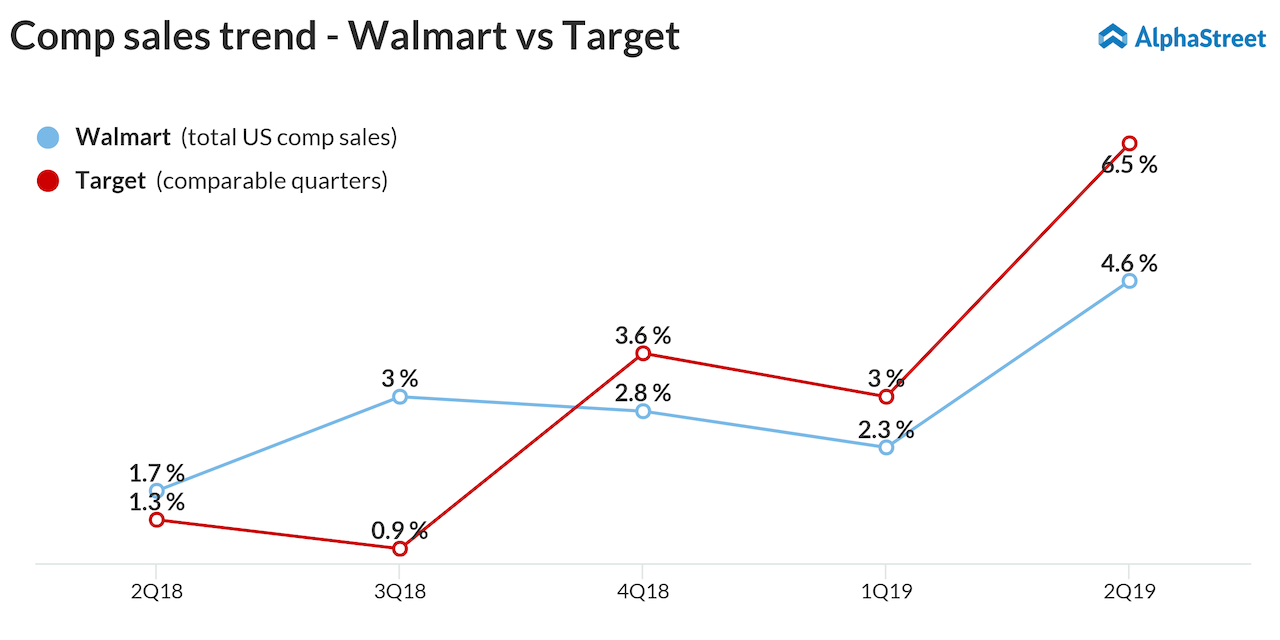
To start with, Target is currently in great shape, reporting a 6.5% increase in same-store sales during the recently ended quarter. This compares with Walmart, which reported just a 4.5% increase in same-store sales for the same period. Separately, WMT stock currently has a price-to-earnings ratio of 53.85, which makes it quite overpriced. On the other hand, TGT stands at a modest price-to-earnings ratio of 14.86. Therefore, if you are a value investor, these figures should do the trick for you.
Target shines even from a dividend perspective as well, though both retailers have healthy payout ratios. Target’s annual dividend stands at $2.48 per share, higher than $2.08 allotted by Walmart. Target also has a slightly higher dividend yield of 3.2% versus Walmart’s 2.5%, which makes it a more attractive dividend stock.
Target is also upping its ante against Walmart and Amazon (AMZN) by offering competitive offers including free two-day shipping without a minimum purchase amount for credit card customers. This is compared with Amazon Prime membership fee of $119 a year for free two-day shipping, as well as free shipping service offered by Walmart on a minimum purchase price of $35.
The Minneapolis, Minnesota-based retailer has been pouring a lot of investments into improving its current stories while shuttering locations that are underperforming. A few key acquisitions, primarily Shipt, have also been made to streamline delivery services – including buying online collect offline options.
Target management had stated during the previous conference call that most people who come to collect their online purchases from stores actually end up buying other items. Apart from this, the management had also said that it would hire 20% more temporary workers for warehouse works this year than last year, to meet the increasing customer demands.
Finally, if you analyze the investor mix of both the companies, you would find that over 85% of Target ‘s ownership is held by institutional investors, which indicates higher investor confidence among money managers and hedge funds. Institutional investors, meanwhile, account for a meager 30% for Walmart.
DISCLAIMER: The article does not necessarily imply the views of AlphaStreet, and contains opinions of the author alone.