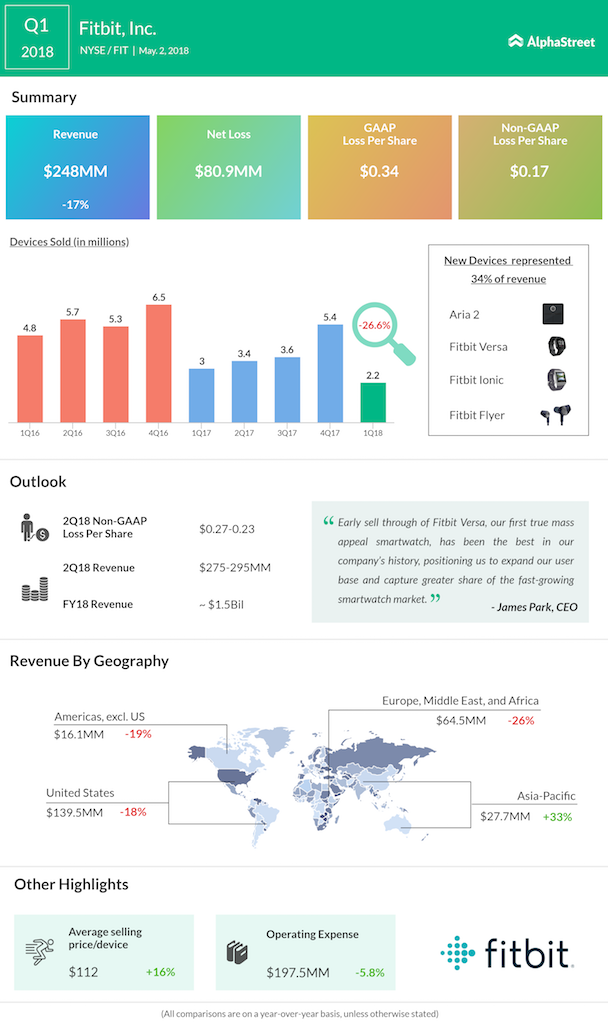
An important question will probably get an answer tomorrow – Is Fitbit (FIT) doing enough to survive in the cut-throat competition in the wearables market? The maker of fitness trackers will report second-quarter earnings at 4:05 PM ET on Wednesday and Wall Street expects to see a loss of 24 cents per share on revenue of $285.9 million, down 19% year-over-year.
Once a pioneer of health-based wearables technology, Fitbit has since floundered due to competition from new entrants, primarily Apple (AAPL). While Apple has been eating up its market share from the high-end segment, a slew of player including Xiaomi, Garmin (GRMN) and Jawbone has set an assault in the low-end segment.

The San Francisco, California-based firm cannot be blamed for being reluctant to innovate either. The company has been aggressively diversifying its portfolio for the past few quarters with more focus on health and wellness to create a niche area for itself. The new product line includes a wearable device for children aged eight years or above called Fitbit Ace. This is the first time a company has come up with a specially designed wearable device for kids.
Fitbit has also been working on improving personalization options in its devices by upgrading its software, besides achieving better integration of its services.
The company has been aggressively diversifying its portfolio for the past few quarters with more focus on health and wellness to create a niche area for itself.
While these are welcome steps to improve the slow growth in which the company is currently hedged in, the bigger question is whether this is enough. So far, these product diversifications and software upgrades have failed to live up to expectation in terms of boosting the top line.
The global wearables market is expected to reach $51.5 billion by 2022, so there is still enough upside for growth. The second quarter results will show how much the company is poised to take down this market.
Fitbit shares have underperformed the industry ‘s growth in the past 52 weeks. While the sector saw a 38% jump during the period, Fitbit grew just 11%.
Related: Fitbit Q1 results