
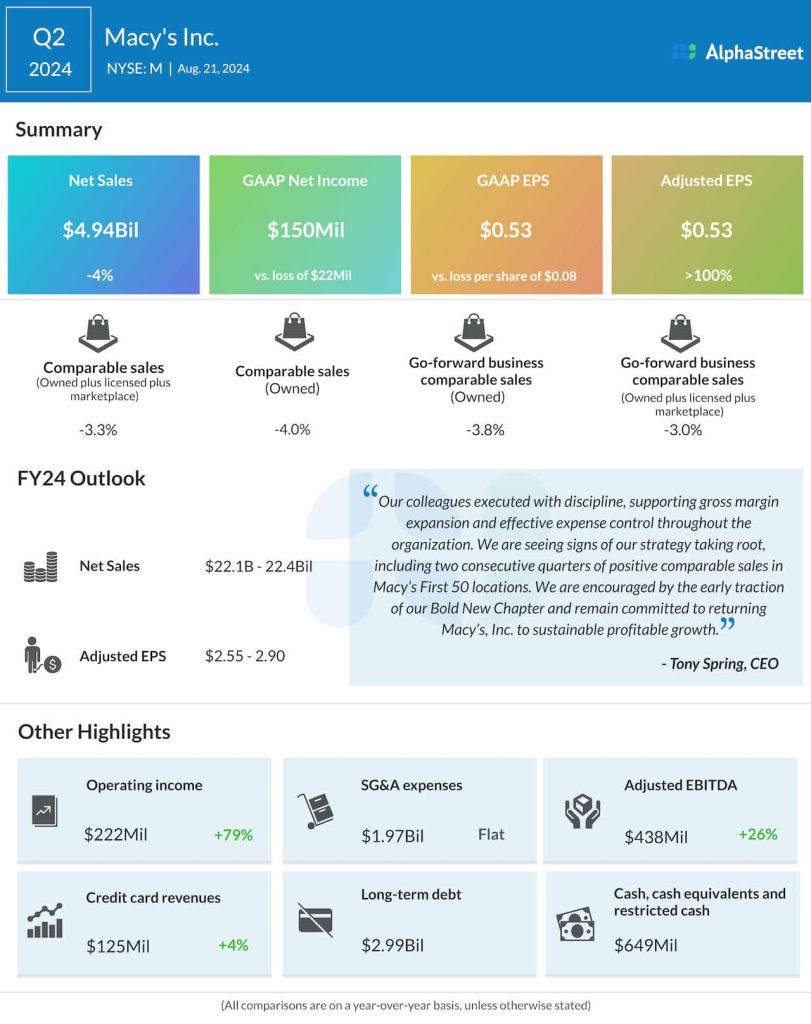
Shares of Macy’s, Inc. (NYSE: M) stayed red on Monday. The stock has dropped 18% over the past three months. The company saw its sales decrease in the second quarter of 2024 but its earnings witnessed strong growth. The retailer has been making significant progress on its Bold New Chapter strategy and it continued to see encouraging performance from its First 50 stores in Q2.
Quarterly performance and strategy
In Q2 2024, Macy’s net sales decreased 3.8% year-over-year to $4.9 billion. Total enterprise comparable sales were down 3.3%. On a GAAP basis, the company reported earnings of $0.53 per share compared to a loss of $0.08 per share last year. Adjusted EPS of $0.53 more than doubled from last year and came above the company’s outlook, benefiting from gross margin improvements and strong expense management.
During the second quarter, continued macroeconomic uncertainty led to customers becoming more cautious on their discretionary spending. Against this backdrop, the company revamped its assortments and promotions, and invested more in areas of product strength while shifting away from areas with softer demand.
In Q2, Macy’s go-forward business comparable sales, defined as go-forward locations plus digital across nameplates, decreased 3%. By nameplate, Macy’s net sales were down 4.4% and comps were down 3.6%. The First 50 go-forward locations comps were up 1%.
Macy’s has been rolling out new market and private brands that meet customer demand, and it continues to diversify its brand portfolio. In categories like home, it is boosting its assortment focused on holiday gifting purposes.
Another important part of Macy’s strategy for its namesake division is closing and monetizing its 150 non-go-forward locations. These locations are valuable real estate assets with strong demand. The company is now looking to close around 55 of these stores this year versus its previous expectation of 50.
In Q2, Bloomingdale’s net sales dipped 0.2% while comp sales dropped 1.4%. Bluemercury’s net sales were up 1.7% while comp sales were up 2%.
Outlook
Looking ahead to the rest of the year, Macy’s anticipates customers to be more cautious than previously expected. It also expects a heightened promotional environment. The company lowered its sales outlook for the full year of 2024 and now expects net sales of $22.1-22.4 billion versus the previous range of $22.3-22.9 billion. Comparable sales are expected to be down 2% to down 0.5%. Adjusted EPS is projected to be $2.55-2.90.
For the third quarter of 2024, net sales are expected to be $4.7-4.82 billion while adjusted EPS is expected to range between a loss of $0.04 to earnings of $0.01.