
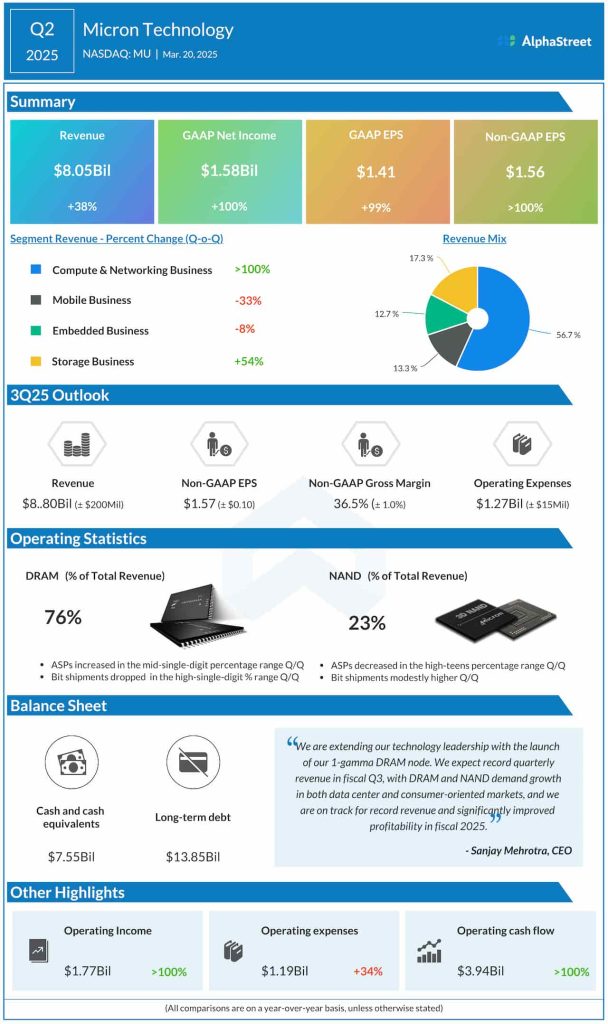
Micron’s (NASDAQ: MU) second-quarter report underscores its leadership position in high-bandwidth memory (HBM) chips and AI-driven data center solutions. The expanding portfolio of high-margin products gives the memory chipmaker a competitive edge. It forecasts record-high revenues for the third quarter, reflecting strong growth in NAND and DRAM shipments.
The market reacted positively to the stronger-than-expected second-quarter results initially, but the optimism waned after the management warned of a sequential drop in third-quarter profit margins and the stock fell sharply in after-hours trading on Thursday. Over the past six months, MU has been trading almost sideways, after retreating from the all-time highs of mid-2024. Coming out of a rough patch, the company appears to be on the path to a full-fledged recovery, making the stock a promising long-term investment.
Data Center Leads
In the second quarter, the Idaho-headquartered tech firm’s adjusted earnings surged to $1.56 per share from $0.42 per share in the year-ago period, exceeding Wall Street’s expectations. On a reported basis, net income was $1.58 billion or $1.41 per share in Q2, compared to $793 million or $0.71 per share in the prior-year quarter. The impressive bottom-line performance is driven by a sharp growth in revenues to $8.1 billion from $5.82 billion last year, aided by record-high revenues in data center DRAM. Earnings and the topline beat estimates for the eighth consecutive quarter.
Commenting on the results, Micron’s CEO Sanjay Mehrotra said at the earnings call, “Micron remains the only company in the world to ship low-power DRAM into the data center in high volume, showcasing our pioneering innovation and deep partnership with our customers for differentiated solutions. As we build on this momentum, we expect fiscal Q3 revenue to be another record for Micron, driven by shipment growth across both DRAM and NAND. We see the combination of AI data center demand and the ramp of HBM and its associated trade ratio contributing to tightness at the leading edge and constraining non-HBM DRAM supply.”
The company said it is expecting a quarter-over-quarter decrease in gross margin to around 36.5% in the third quarter, mainly due to the effects of higher consumer-oriented volumes. Another factor that weighs on margin performance is continued NAND underutilization. However, those headwinds seem temporary as the business is uniquely positioned to benefit from the growing demand for high-bandwidth memory chips. The guidance for Q3 adjusted EPS is $1.57, while revenue is expected to increase to a record high of $8.8 billion.
Capacity Expansion
Taking a cue from the widespread shift in tech investments to AI data centers, Micron is currently focused on expanding high-bandwidth capacity in its existing manufacturing facilities to meet requirements through 2026. For the third quarter, the Micron leadership forecasts operating expenses of around $1.13 billion and sees a 10% increase in FY25 opex, due to expenses related to the development of high-value products, including HBM.
Micron’s shares have lost about 15% in the past twelve months. On Friday, they dropped 8% in the early hours of the session, reflecting subdued investor sentiment following the weak margin forecast.