
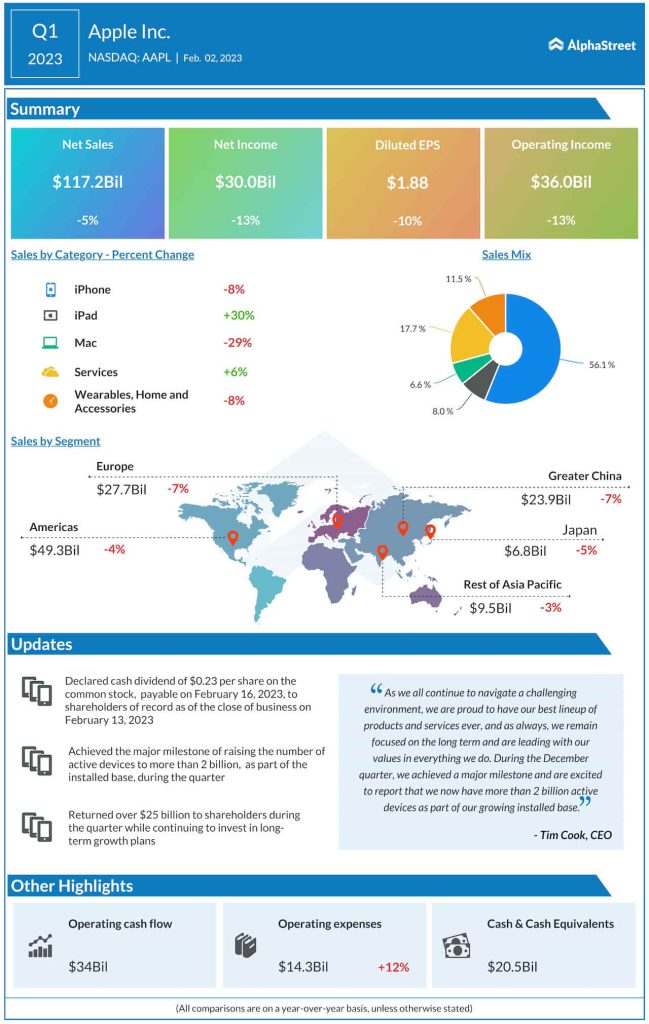
Apple Inc. (NASDAQ: AAPL) this week reported its first revenue decline in more than three years, even as the high inflation continues to squeeze customers’ spending power. Sales of the gadget giant’s flagship product — iPhone — and the Mac personal computer declined, as people cut down on discretionary expenses. Of late, persistent supply chain issues in China, where the company has many production facilities, and global economic uncertainties have been a drag on sales.
Stock Intact
Interestingly, Apple’s stock recovered quickly from the brief dip that followed the earnings announcement and made decent gains in the early hours of Friday. It is worth noting that the cause of the current slump is not specific to the company, rather it is due to external factors like the global economic downturn, rising prices, the Ukraine war, and unfavorable exchange rates.
Read management/analysts’ comments on Apple’s Q1 2023 results
While Apple withheld its quarterly guidance ever since the pandemic tightened its grip on markets, the management is bullish on the rapidly growing services segment that has emerged as a main growth driver. Apple executives do not see a meaningful sales recovery in the near term since the present challenges are likely to persist. In the latter part of the first quarter, shipments of the recently launched iPhone-14 Pro and iPhone-14 Pro Max were affected by supply issues caused by the pandemic.
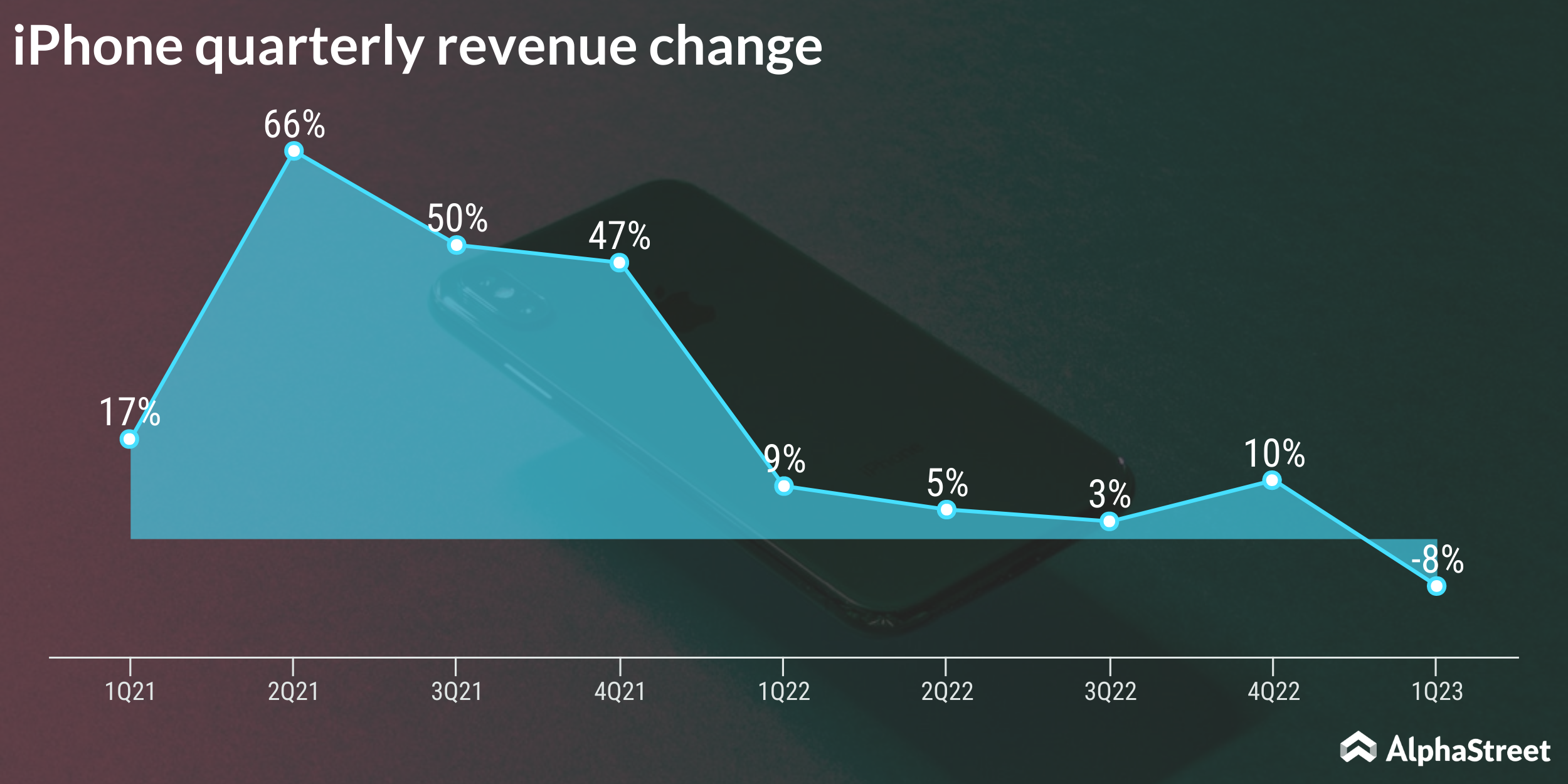
On the positive side, production has returned to normal levels, with manufacturing facilities now operating at their pre-COVID capacities. Also, the company has achieved the important milestone of increasing the number of active devices to two billion, as part of its growing installed base.
Weak Q1
Sales of iPhone, which accounts for more than half of total revenues, dropped 8% in the December quarter. It was partially offset by continued growth in the Services division, which is the second-largest operating segment now. Among the other products, sales of Wearables and Mac declined, while iPad sales grew an impressive 30%.
All five geographical segments witnessed negative growth in the first quarter and total sales came in at $117.2 billion, down 5% year-over-year. As a result, net income declined sharply to $30 billion or $1.88 per share. The company did not issue revenue guidance for the current quarter, citing the continuing uncertainty.
Earnings: Highlights of Intel’s Q4 2022 financial results
However, Apple’s CFO Luca Maestri provided an update without specifying the numbers – “For services, we expect revenue to grow year-over-year while continuing to face macroeconomic headwinds in areas such as digital advertising and mobile gaming. For iPhone, we expect our March quarter year-over-year revenue performance to accelerate relative to the December quarter year-over-year revenue performance. For Mac and iPad, we expect revenue for both product categories to decline double digits year-over-year because of challenging compares and macroeconomic headwinds.”
Tech Slump
Underscoring the widespread slowdown in the tech sector, marking a retreat from the COVID-driven boom, Google’s parent Alphabet Inc. (NASDAQ: GOOG, GOOGL) this week reported muted revenue growth and a sharp fall in earnings for the latest quarter. Elsewhere, earnings of eCommerce titan Amazon.com, Inc. (NASDAQ: AMZN) fell year-over-year despite an increase in revenues.
AAPL traded up 4% on Friday afternoon, continuing the recovery that started at the beginning of the year. The stock has lost about 6% in the past six months.