
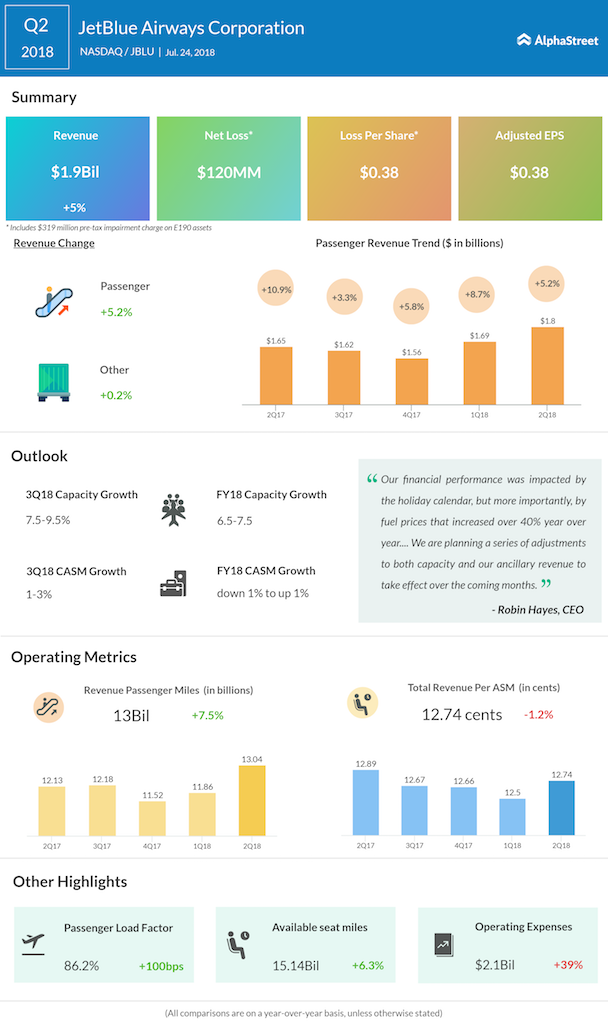
JetBlue Airways (JBLU) reported a 5% increase in operating revenues to $1.92 billion for the second quarter of 2018 compared to the same period last year. This includes a 5.2% growth in total passenger revenue. Shares of JetBlue increased about 1% in the pre-market trading session.
The company reported a net loss of $120 million or $0.38 per share during the quarter compared to a net income of $207 million or $0.62 per share in the prior-year period. Q2 2018 earnings were hurt by a $319 million pre-tax impairment charge on E190 assets. Excluding this charge, adjusted diluted EPS was $0.38. Revenues came in line with analyst expectations while adjusted EPS beat estimates.
Revenue per available seat mile (RASM) fell 1.2% year-over-year. This included 2.5 points of negative impact from holiday travel that shifted into the first quarter. Operating expenses per available seat mile (CASM), excluding fuel, grew 1.9%. Load factor improved 1 point to 86.2%.
For the third quarter of 2018, JetBlue expects capacity to increase between 7.5% and 9.5% year-over-year. RASM growth is expected to range between flat and 3% while CASM, ex-fuel, is expected to grow 1% to 3%. For the full year of 2018, the company expects capacity to increase 6.5% to 7.5%.

JetBlue signed an MOU for the purchase of 60 A220 aircraft from 2020 to 2025 and announced a transition plan for its current E190 fleet. The deal is expected to mitigate cost increases over the next ten years and strengthen the airline’s network strategy.
The airline achieved $154 million in 2020 run rate savings by the end of Q2 as a result of its Structural Cost Program and looking towards the second half of the year, it expects an inflection in its unit cost trends as benefits from the cost program build.
Last week, JetBlue announced layoffs and reorganizations as part of its efforts to reduce operating costs by up to $300 million by 2020. The company said it is taking steps to adjust to the higher oil prices.