
Ocean Biomedical, Inc. (NASDAQ: OCEA), a biopharma company that works with research universities and medical centers for developing and commercializing their discoveries, on Thursday said its scientific co-founder Jonathan Kurtis received a Notice of Allowance from the United States Patent and Trademark Office for his U.S. patent application covering a therapeutic and prophylactic monoclonal antibody that kills falciparum malaria parasites.
The United States Patent and Trademark Office is expected to issue a patent from Dr. Kurtis’ application in the coming months. The patent allowance will allow the team to pursue the development of the monoclonal antibody as both a potential therapeutic drug for individuals with severe malaria infection as well as a potential short-term prophylactic treatment to prevent malaria infection in travelers, overseas deployed military and government personnel, and individuals living in areas with short malaria transmission seasons.
“As the current drugs began to fade, we are pleased to have a drug candidate that could offer a treatment option for severe malaria patients, and one that would be well-suited to use for malaria prophylaxis for travelers, military deployments, and short-term exposure areas,” said Ocean Biomedical’s chairman and co-founder Dr. Chirinjeev Kathuria.

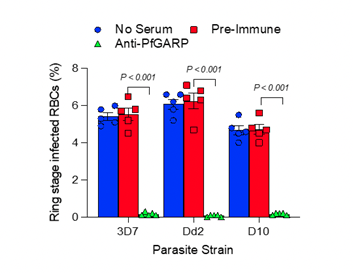
Anti-PfGARP Efficacy in vitro (green triangles show effect of anti-PfGARP)
(Source: Ocean Biomedical, Inc.)
Dr. Kurtis has discovered and produced a monoclonal antibody that binds to PfGARP, a parasite-derived protein secreted during the blood stage of malaria, and triggers the malaria parasite to kill itself. The discovery is based on a groundbreaking discovery he made earlier, that PfGARP is potentially a highly effective vaccine target for malaria.
“Inducing parasite cell death via targeting PfGARP is a novel approach that has potential to launch a whole new class of antimalarials, including mRNA-based vaccines, small molecules, and the current monoclonal antibody. Our monoclonal comes at a critical time because malaria parasites are developing resistance to current frontline therapeutics and because the currently approved vaccine offers only very limited protection,” said Dr. Kurtis.
Data show that the family of small molecule candidates in development by Dr. Kurtis’ team are highly specific for PfGARP binding, are non-toxic in multiple in vitro and in vivo systems, have excellent pharmacokinetic properties, and rapidly clear parasitemia in animal models. The discovery has allowed Ocean Biomedical to begin simultaneously pursuing the development of a novel malaria vaccine, and novel malaria therapeutics.
“Like all of Ocean Biomedical’s pre-clinical programs, this malaria treatment has the potential to meet large, unmet medical needs that can benefit our shareholders, and a large population globally,” said Suren Ajjarapu, one of Ocean’s directors.