
AbbVie Inc. (NYSE: ABBV) has long been fighting to delay the entry of generic alternatives to Humira, the pharma giant’s flagship product whose patent is now expected to expire in about a decade. The fact that the popular arthritis drug accounts for nearly half of the company’s annual revenue make the transition significant. Investors will be closely following Friday’s earnings event, looking for insights into the company’s long-term strategy.
The Illinois-based biopharmaceutical firm, which has reported stronger-than-expected earnings consistently in recent years, is expected to earn $2.83 per share in the first quarter, on an adjusted basis, representing a 16% year-over-year increase. Analysts also project a 48% growth in revenues to $12.76 billion. It is scheduled to publish the results on Friday.
Investing in AbbVie
The company has been riding the stable performance of its immunology portfolio. Emerging from the pandemic-induced slump, AbbVie’s stock maintained an uptrend since the second half of 2020 and is currently trading at a three-year high. It is expected to gain further – about 15% in the next twelve months. The majority of analysts following the stock, which has been quite popular among dividend investors, recommend buying it.
Growth Drivers
Besides Humira, immunology drugs Skyrizi and Rinvoq have been the main growth drivers. Once the company pivots away from Humira, they are expected to cover almost all of the former’s major indications as well as new disease areas. Synergies from the deal with Allergan, which joined the AbbVie fold last year, should complement that. On the positive side, the integration is progressing well despite the size of the transaction and COVID-related uncertainties. Meanwhile, margins could come under pressure from elevated costs, mainly R&D and SG&A expenses.
From AbbVie’s fourth-quarter 2020 earnings conference call:
“The acquisition of Allergan brought us a substantial neuroscience portfolio with compelling therapies for migraine and psychiatric conditions augmenting our already existing neuro franchise. The newly combined neuroscience franchise delivered nearly $4.9 billion in comparable 2020 revenue and is expected to grow double-digits in 2021. We also added the leading global Aesthetics franchise, a largely cash pay portfolio with roughly $3.5 billion in comparable 2020 revenues.”
Q4 Performance
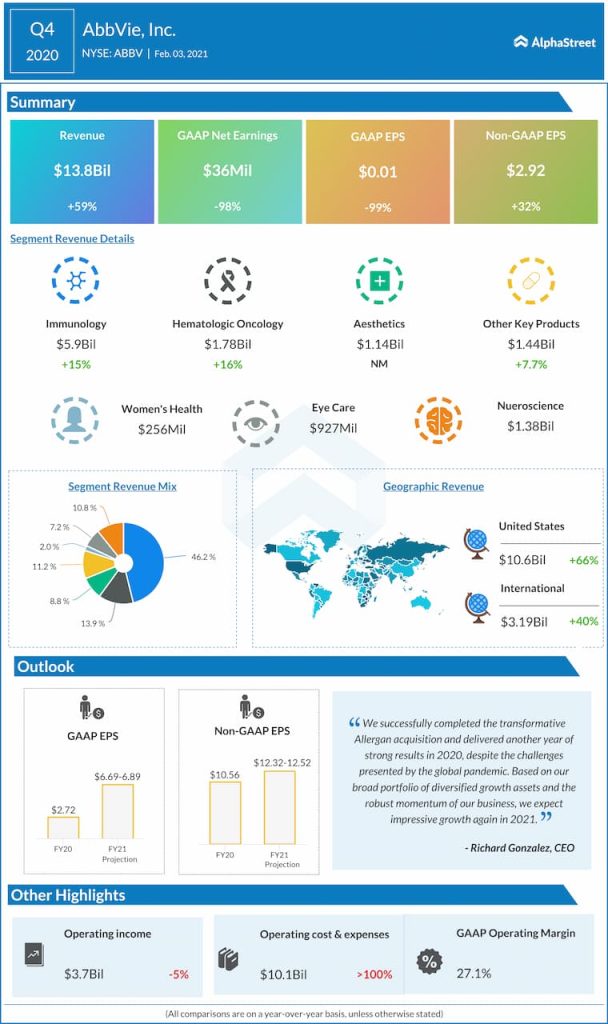
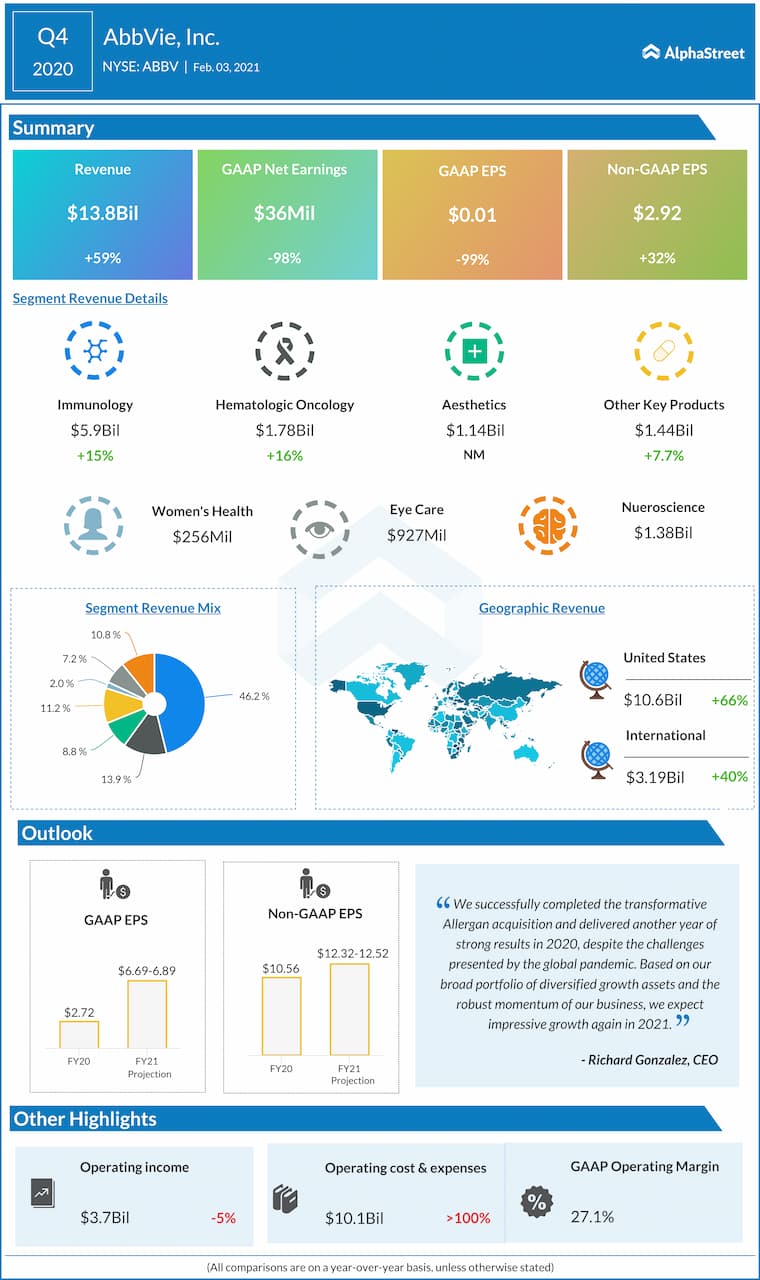
Driven by broad-based sales growth, revenues surged 59% annually to $13.8 billion in the fourth quarter of 2020. As a result, adjusted earnings moved up 32% to $2.92 per share. The numbers also exceeded the consensus estimates.
Read management/analysts’ comments on quarterly earnings
AbbVie’s shares closed Thursday’s regular session lower, after trading down throughout the day. ABBV entered 2021 on a high note but experienced volatility after that. The stock has gained 5% since the beginning of the year.