
Shares of Beyond Meat, Inc. (NASDAQ: BYND) stayed red on Wednesday. The stock has dropped 64% over the past 12 months. Earlier this week, the company delivered disappointing results for the second quarter of 2023 and a bleak outlook for the full year. Here are four factors that do not work in favor of this plant-based foods producer:
Sales declines
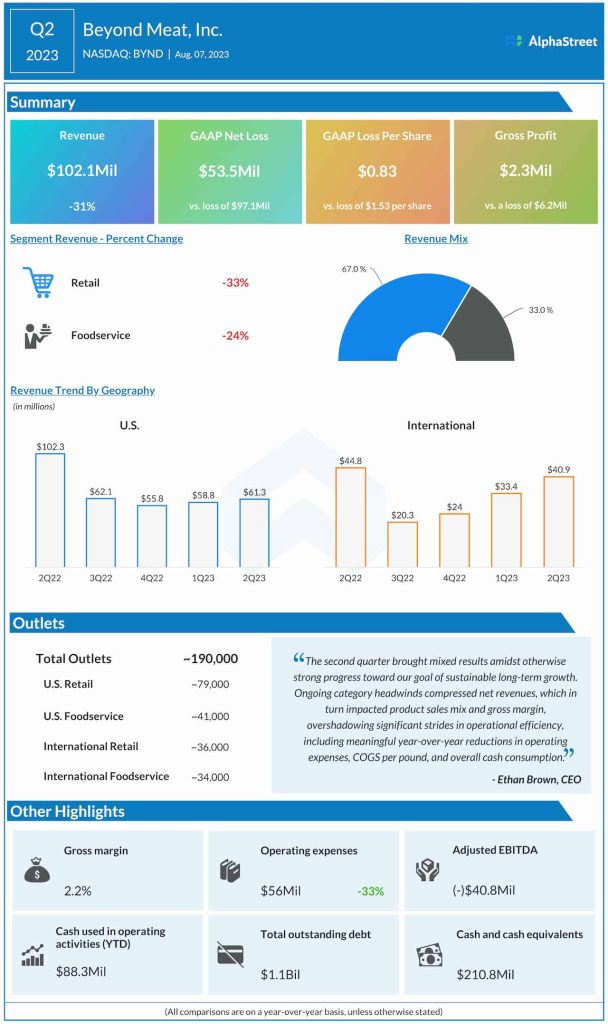
Beyond Meat’s sales have continued to decline over the past couple of quarters. In Q2 2023, net revenues fell 30.5% to $102.1 million, driven by decreases in volume of products sold and net revenue per pound. The volume decline was caused by weak category demand while the drop in net revenue per pound was due to changes in product sales mix and higher trade discounts.
The company’s revenues decreased across its domestic and international retail and foodservice channels as well. Within the US, weak category demand led to lower volumes and net revenue per pound in both retail and foodservice.
Meanwhile, the international retail channel benefited from a nearly 3% increase in net revenue per pound due to changes in product sales mix, and the foodservice channel saw a 19% growth in volume, reflecting strong sales to large QSR customers in the EU.
Continued losses
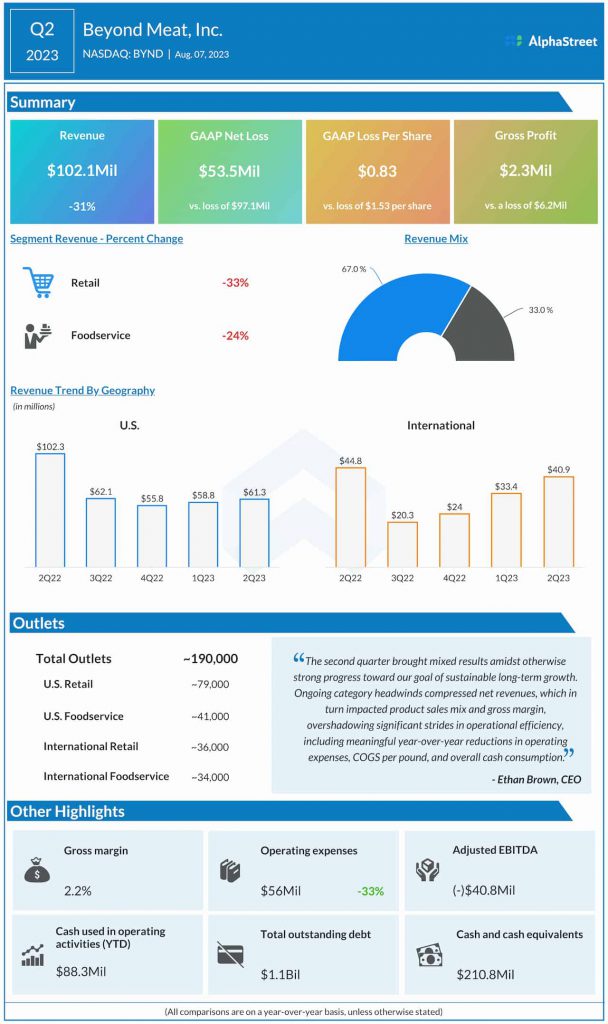
Beyond Meat continues to deliver losses. In Q2, net loss was $53.5 million, or $0.83 per share. However, this was narrower than the loss of $97.1 million, or $1.53 per share, reported in the year-ago period.
Market headwinds
Beyond Meat continues to face challenges related to pricing, tough competition and health benefits. Its plant-based food products are expensive compared to traditional meat options, and therefore in an inflationary environment, customers are more likely to choose meat over plant-based alternatives.
There is also a general lack of clarity about the health benefits of plant-based food products. As the fad begins to die down, the demand for plant-based food products could also go down, posing a risk for sales. In addition, Beyond Meat faces stiff competition in the plant-based products space from processed food companies that have rolled out their own plant-based offerings.
Outlook
Beyond Meat lowered its outlook for the full year of 2023. The company now expects net revenues of $360-380 million versus its previous range of $375-415 million. Gross margin is now expected to be in the mid to high single-digit range versus the prior expectation of low double-digit range. The company also said it would not be able to achieve cash flow positive operations in the second half of the year, as previously expected, due to lower demand.