
IPOs continue to be attractive to investors for a multitude of reasons. They provide an opportunity to get in on the ground floor of a company that is usually growing sales at a rapid pace. On the flip side, there is a chance that investors might lose significant capital if the company’s management fail to execute as per expectations.
One of the companies that recently went public is Lemonade (NYSE: LMND). This insurance company priced its IPO at $29 per share and raised $319 million in the public issue on July 1. It has gained significant momentum since then. Lemonade stock is currently trading at $80.85, valuing the company at a market cap of $4.44 billion.
Let’s take a look to see if Lemonade stock can continue to beat the broader markets in 2020 and beyond. Here we deep dive into the company’s business model to gauge its potential to grow revenue in the upcoming decade.
Lemonade is looking to disrupt the insurance space
Lemonade aims to rebuild insurance from the ground up with its innovative business model. It plans to leverage technology, data, and artificial intelligence capabilities to make insurance an affordable process.
Also read: Lemonade Inc. (LMND) Q2 2020 Earnings Call Transcript
Lemonade has built a vertically integrated company with wholly-owned insurance carriers in the U.S. and Europe. It offers homeowners and renters insurance in the U.S. and contents and liability insurance in Germany and The Netherlands. Its now expanding into other verticals such as pet insurance.
In a departure from the traditional insurance business model, Lemonade retains a fixed fee which is 25% of premiums that suggests its gross margins will remain rangebound in good times and bad. The company also states excess claims are offloaded to reinsures while excess premiums are usually donated to non-profits selected by the customer.
A look at the company’s key metrics
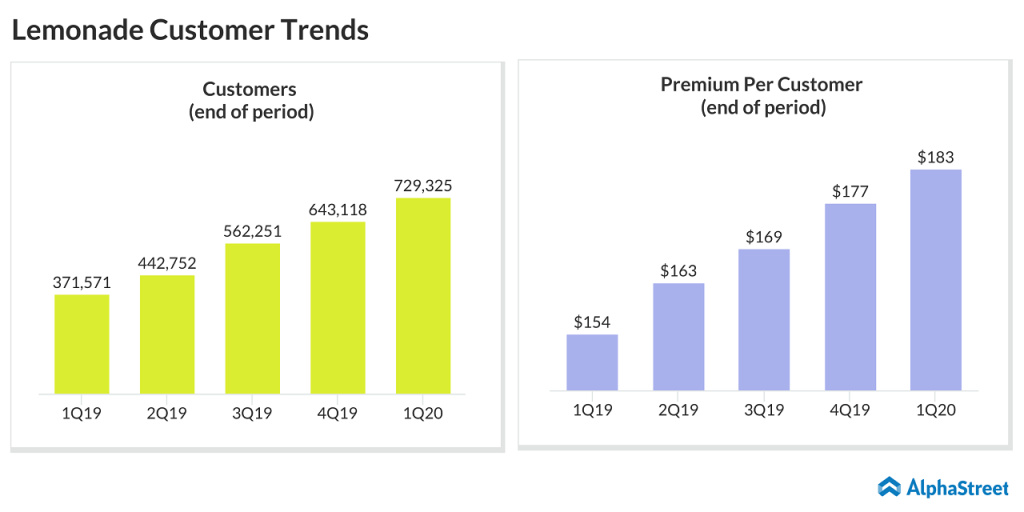
According to the insurance company, as customers progress through lifecycle events, insurance needs normally grow to encompass higher-value products. For example, renters regularly acquire more property and upgrade to larger homes while home buying coincides with a growing household that generates demand for products such as pet insurance, among others.
These progressions should trigger a jump in insurance premiums over time, which will result in recurring and expanding revenue streams.
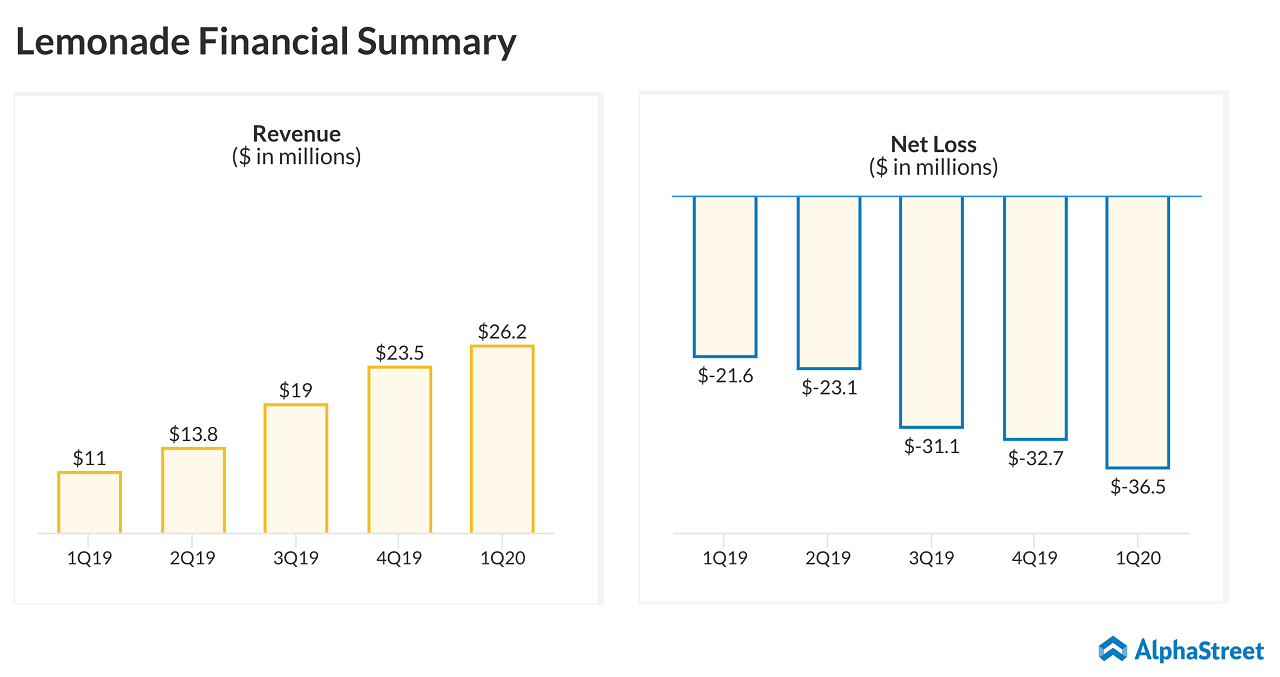
Lemonade launched in late 2016 and has managed to increase its gross written premium from $9 million in 2017 to $116 million in 2019. In the first quarter of 2020, this figure stood at $38 million.
Lemonade’s sales rose from $2 million in 2017 to $67 million in 2019 and $26 million in the first quarter of 2020. Comparatively, its net losses rose from $28 million in 2017 to $109 million in 2019 and $37 million in Q1.
While Lemonade continues to post a net loss, it has managed to reduce its gross loss ratio from 161% in 2017 to 72% in the first quarter of 2020.
[irp posts=”66358″]
The final word
Insurance is one of the largest industries in the world and life insurance premiums amount to $5 trillion at the global level. Insurance accounts for 11% of the GDP in the U.S. However, this has also attracted major players that have built large and enduring businesses.
Lemonade is competing in a space where leaders have built a massive presence over the decades. But it is also leveraging technology that will help it gain millennial customers at a rapid pace. Similar to most other IPOs, Lemonade stock will continue to remain volatile until it can significantly improve profit margins and generate recurring cash flows. But like other early-stage firms it also provides an opportunity to build wealth for investors with larger risk appetite.
[irp posts=”66239″]
______